English
 Czech
Czech
 German
 French
 Italian
 Japanese
 Polish
 Spanish
 13 min read
What are SCADA Communication Protocols?
Supervisory Control and Data Acquisition (SCADA) communication protocols are standardized languages that enable industrial devices, controllers, and software systems to exchange data reliably in real-time.
These protocols form the foundation of industrial digitalization by ensuring equipment from different vendors can communicate seamlessly—whether it’s a flow meter in a remote water plant or an HVAC system in a smart building.
Key Benefits:
- Enable interoperability between multi-vendor systems
- Support real-time visualization, monitoring, and control capabilities
- Provide secure, reliable data exchange for critical infrastructure
- Reduce integration costs and complexity
What You’ll Learn in This Blog
- Why communication forms the foundation of SCADA and industrial digitalization
- How SCADA protocols vary across key verticals like discrete and process manufacturing, energy, buildings, and utilities
- Which protocols are most widely used and why
- How third-party integrations help expand communication capabilities
- How the GENESIS SCADA platform by Mitsubishi Electric Iconics Digital Solutions enables advanced, flexible connectivity
Why SCADA Communication Powers the Digital Era
Just like every great team relies on strong communication, every successful industrial system depends on it too. Communication has long been the lifeblood of Supervisory Control and Data Acquisition (SCADA) systems, and in today’s IIoT-driven world, communication forms the very foundation of digitalization.
Industrial digitalization depends on the ability of assets, software platforms, and control equipment to share information in real time. Whether it's a flow meter in a remote water plant or an HVAC system in a smart building, SCADA systems must speak the right “languages” to unlock insights and orchestrate control.
The story of digital transformation, in many ways, is the story of communication protocols.
That’s why SCADA platforms must be capable of seamlessly connecting across diverse equipment and systems using industry-specific protocols.
So, what does this mean for your operation? Let's explore the most important protocols for major industrial verticals, highlight the advantages of native connectivity to Mitsubishi Electric equipment, and explain how third-party providers can extend communication even further.
Which SCADA communication protocols does your industry use?
Now that we understand why protocols matter, let’s look at the specific protocols commonly used across different industries. Each sector relies on a mix of standard and specialized protocols to connect devices, systems, and applications.
Below is an overview of the most widely used SCADA communication protocols across key industries:
Building Automation SCADA Protocols
Core Building Management Protocols:
- BACnet – ANSI/ASHRAE standard since 1987
- BACnet/SC – Secure Connect variant
- LonWorks – ANSI standard since 1999
- RESTful APIs – For modern IIoT device integration
- MQTT – Lightweight messaging protocol ideal for IIoT
- Modbus (Serial and TCP/IP)
- OPC UA and OPC Classic
- SNMP (v1 and v2)
- Model Context Protocol (MCP)
- ODBC/OLE-DB – Database integration
- File-based interfaces – Support for multiple file formats
Power & Utilities SCADA Protocols
Essential Utility Communication Standards:
- DNP3 – Distributed Network Protocol for utility communications
- IEC 61850 – International standard for electrical substation automation
- IEC 60870 – Telecontrol equipment and systems standard
- Modbus (RTU, Serial, TCP/IP)
- RESTful APIs and MQTT
- OPC UA and OPC Classic
- SNMP, MCP, ODBC/OLE-DB, file interfaces
- Triangle Microworks – Advanced IEC 61850/DNP3 integration
Oil & Gas SCADA Protocols
Critical Energy Sector Communication:
- AUTOSOL – Robust protocol coverage and data acquisition
- EFM/AMR interfaces – Electronic Flow Measurement/Automatic Meter Reading
- Modbus derivatives for flow computers
- RESTful APIs, MQTT
- OPC UA and OPC Classic
- SNMP, MCP, ODBC/OLE-DB, file interfaces
Water & Wastewater SCADA Protocols
Water Management Communication Standards:
- PLC protocols
- RTU protocols (e.g., Bristol Babcock)
- DNP3 with WITS – Water Information Transfer System
- HART and WirelessHART – Highway Addressable Remote Transducer
- Modbus, RESTful APIs, MQTT
- OPC Classic and OPC UA
- SNMP, MCP, ODBC/OLE-DB, file interfaces
Manufacturing SCADA Protocols
Industrial Production Communication:
- PLC protocols via OPC UA and OPC Classic
- Mitsubishi Electric native protocols
- Ethernet/IP, Profibus, Profinet, EtherCAT, CC-Link
- RESTful APIs, MQTT
- Modbus (Serial, RTU, TCP/IP)
- OPC UA and OPC Classic
- SNMP, MCP, ODBC/OLE-DB, file interfaces
- Partner integrations – Takebishi, Autosol
Managing connectivity across industries can quickly become complex, given the sheer variety of protocols in use today.
How does GENESIS simplify SCADA protocol complexity?
The diversity of protocols—differing by industry, vendor, and application—often makes it difficult for organizations to unify devices and systems within a single SCADA environment.
That’s where GENESIS from Mitsubishi Electric Iconics Digital Solutions delivers the real advantage. Instead of requiring bolt-on solutions or multiple middleware layers, GENESIS comes with deep native support for the most widely used protocols built right in.
We have identified three distinct types of connectivity and, over the years, have refined GENESIS to excel at each:
- Industry Standard Protocols – GENESIS natively supports a broad set of industry-standard protocols. These standards form the foundation of GENESIS connectivity and demonstrate a core area of technical differentiation, both in depth of support and performance.
- Leading Vendor Protocols – Leading vendor protocols include proprietary communication standards that automation vendors develop and maintain. Vendors supply the software that enables third-party integration. By adopting OPC, Mitsubishi Electric Iconics Digital Solutions ensures GENESIS delivers high-quality, high-performance communications with client applications. Robust vendor protocol support, particularly OPC technology, gives GENESIS a competitive advantage and positions our company as a leader in OPC connectivity.
- Ancillary Protocols – Ancillary protocols (specialized or less common communication methods used in niche or vertical industries) extend connectivity where standard or vendor protocols may not apply. Instead of attempting to master them all, our company relies on GENESIS’s advanced OPC support to integrate domain-specific protocols from third-party experts. We primarily work with Takebishi’s DeviceXPlorer OPC Server as the preferred provider, but GENESIS also integrates with a wide range of additional providers.
In every case, GENESIS ensures reliable, high-performance connectivity that enables organizations to unify systems, streamline operations, and gain a competitive advantage.
What makes GENESIS native SCADA protocol support unique?
The GENESIS SCADA software is built with industry standard connectivity in its DNA. Few platforms offer such a rich library of built-in, tested, and trusted standards-based protocol support.
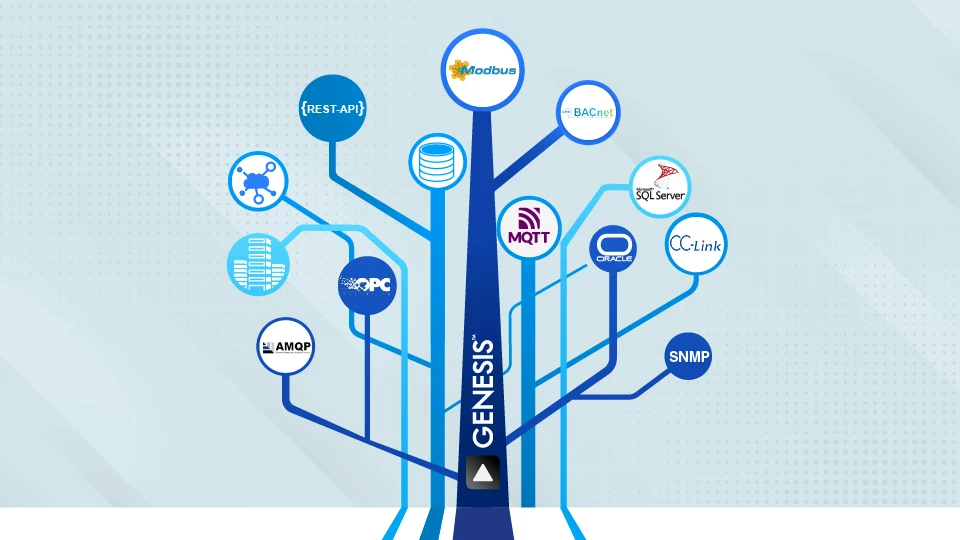
GENESIS natively supports:
- Mitsubishi Electric equipment – PLCs, inverters, robots, and drives
- BACnet and BACnet/SC
- OPC connectivity: UA and OPC Classic, including DA, AE, HDA, and A&C
- Modbus variants – Serial, RTU, TCP/IP
- IIoT protocols – MQTT and RESTful APIs
- Network management – SNMP (v1 and v2)
- Database integration – ODBC and OLE-DB
- File system interfaces – Multiple file format support
This depth and breadth of connectivity make GENESIS uniquely capable of serving as the digital backbone for industrial, infrastructure, and building automation projects alike—delivering secure, reliable, and future-ready interoperability.
But what happens when you need to connect something truly specialized or legacy? That’s where strategic partnerships can come into play.
SCADA Connectivity with Third-Party OPC Integrations
GENESIS provides extensive, built-in connectivity to the most widely used protocols and systems across industries. For organizations that need to integrate specialized hardware or niche protocols, trusted third-party OPC providers further extend that flexibility.
OPC (Open Platform Communications) is a family of interoperability standards that allows industrial devices, software, and control systems to exchange data securely and reliably—regardless of vendor. First introduced in the 1990s by the OPC Foundation, OPC marked the beginning of the open protocol movement in industrial automation, breaking down the silos created by proprietary systems.
Trusted OPC partners build on this foundation—delivering proven communication tools that help integrate even the most unique devices and systems. By combining the native depth of GENESIS with partner solutions, organizations can achieve truly seamless, future-ready interoperability. (For readers who need comprehensive protocol coverage, a complete list of supported third-party communications is included in the appendix after the conclusion.)
Below are highlights of the major providers that extend GENESIS connectivity across industries:
AUTOSOL (Current Resale Partner)
- Delivers extensive coverage of flow computers and RTUs for oil & gas
- Supports native protocols such as ABB Totalflow, Fisher ROC, and Emerson Bristol Babcock BSAP
- Provides strong DNP3 and Modbus variants
- Enables advanced EFM integrations, including Flow-Cal and Quorum PGAS-XML
Takebishi (Current Resale Partner)
- Provides robust OPC servers with deep Mitsubishi Electric connectivity and broad support for Japanese and global OEMs
- Supports protocols such as Mitsubishi Electric MELSEC, Siemens SIMATIC, Rockwell Automation AB, and Omron SYSMAC
- Covers CNCs, robotics, and energy-saving equipment
- Adds support for BACnet, EtherNet/IP, and IEC 61850
Kepware (Past Resale Partner)
- Offers broad, flexible connectivity across industries
- Supports native protocols such as Allen-Bradley ControlLogix, Siemens S7, Mitsubishi Electric, and GE PLCs
- Provides building automation standards like BACnet/IP and IIoT protocols such as MQTT
- Maintains a strong presence in discrete and process manufacturing
- Provides strong support for utilities and legacy system integration
- Supports DNP3, IEC 61850, and BACnet
- Connects systems including Foxboro, Honeywell Measurex, and Triconex
- Integrates databases such as SQL, Oracle, and MySQL
Collectively, these providers ensure no protocol is out of reach—whether integrating older RTUs, connecting flow computers in oil & gas, linking to building automation systems, or extending connectivity across manufacturing and utilities. By pairing GENESIS with these OPC solutions, organizations can unify even the most diverse environments with confidence.
Beyond this broad ecosystem, our company also works especially closely with a few trusted partners. These relationships go a step further, giving customers the assurance of fully supported solutions backed by our company from purchase through long-term use.
GENESIS SCADA Resale Partners for Extended Connectivity
To reinforce this ecosystem, we maintain strategic resale relationships with select OPC vendors. These partnerships provide customers with full lifecycle support—from product purchase to commissioning and long-term use—while ensuring solutions are fully tested and trusted.
Whenever possible, we recommend using OPC servers offered directly by automation equipment manufacturers, as they often provide the most seamless integration. However, when specialized connectivity is required beyond our native drivers, mature and market-leading third-party providers extend that flexibility.
- AUTOSOL – Delivers broad oil & gas protocol coverage, including native support for Totalflow, ROC, ABB, and more, along with powerful EFM integrations.
- Takebishi – Specializes in robust OPC servers for Mitsubishi Electric equipment as well as major automation vendors such as Rockwell, Siemens, and Omron.
These formal partnerships give customers the added assurance of complete solution support, backed by Mitsubishi Electric Iconics Digital Solutions at every stage—from implementation through long-term operation.
Why SCADA Connectivity Is Your Industrial Competitive Advantage
In today’s digitalized world of industry and buildings, success depends on the ability to connect devices, communicate across systems, and control operations.
Below is the tangible business value that unified SCADA communication creates:
- Reduced integration costs – Native protocol support eliminates expensive middleware
- Faster deployment – Pre-built drivers accelerate project timeline
- Lower operational risk – Proven, tested connectivity ensures reliability
- Future flexibility – Open standards prevent vendor lock-in
- Scalable growth – Add new systems without architectural changes
GENESIS gives organizations the power to unify operations with broad, native, and reliable protocol support. And when native drivers aren’t enough, our partnerships with trusted providers extend those capabilities even further.
Whether you’re modernizing a plant and addressing the complexity of connecting disparate assets and systems, optimizing a smart building, or managing a remote utility, GENESIS provides the universal connectivity foundation needed to accelerate your digital transformation.
Frequently Asked Questions About SCADA Communication Protocols
What are SCADA communication protocols?
SCADA communication protocols are standardized “languages” that allow industrial devices, controllers, and software systems to exchange data securely and reliably in real time. These protocols provide the foundation for interoperability, ensuring that equipment from different vendors can work together seamlessly.
Why are SCADA protocols important for industrial digitalization?
Protocols form the backbone of industrial digitalization. They enable assets, sensors, and control systems to share data across the enterprise, making connected operations, predictive insights, and scalable automation possible. Without them, digital transformation efforts cannot achieve their full potential.
Which SCADA protocol is most commonly used?
Protocol adoption depends on the industry.
- Building automation – often relies on BACnet.
- Utilities – widely use DNP3 and IEC 61850.
- Manufacturing, water, and oil & gas – frequently depend on Modbus.
Across all these sectors, OPC UA is becoming the unifying choice, recognized for its secure, vendor-neutral connectivity.
How does GENESIS support communication protocols?
GENESIS by Mitsubishi Electric Iconics Digital Solutions offers extensive native support, including:
- Mitsubishi Electric equipment protocols (PLCs, inverters, robots, and drives)
- Building automation standards (BACnet and BACnet/SC; visit BACnet Committee for certifications)
- OPC connectivity (UA and Classic: DA, AE, HDA, and A&C)
- Modbus variants (Serial, RTU, TCP/IP)
- IIoT protocols (MQTT and RESTful APIs)
- Network management (SNMP v1 and v2)
- Database integration (ODBC and OLE-DB)
- File-based interfaces (multiple file formats)
Can SCADA systems connect to older or niche equipment?
Yes. When native drivers are not available, third-party OPC providers such as AUTOSOL, Takebishi, Kepware, and Matrikon offer specialized protocol solutions. These tools integrate legacy devices and niche systems into modern SCADA platforms, protecting existing investments while extending system functionality.
What role do modern IIoT protocols play in SCADA systems?
Protocols such as MQTT and RESTful APIs are key for integrating IoT sensors, mobile apps, and cloud platforms. They extend SCADA systems beyond plant-floor control into enterprise ecosystems, enabling smarter business decisions, remote access, and data-driven services.
How do SCADA communication protocols impact cybersecurity?
Protocols designed with security in mind—such as OPC UA and BACnet/SC—use encryption and authentication to defend against cyber threats. When paired with a secure-by-design SCADA platform like GENESIS, they strengthen resilience, support compliance, and safeguard critical infrastructure.
Ready to unify your industrial communications?
Stop struggling with protocol complexity. GENESIS delivers the most comprehensive native protocol support in the industry, plus partnerships that extend connectivity to any device or system.
Get started today:
- Request our GENESIS brochure.
- Contact us to schedule a consultation with our SCADA connectivity experts
- Download GENESIS to see how it can connects your specific equipment
Don’t let communication barriers limit your digital transformation. With GENESIS, every protocol is within reach.
Appendix: Comprehensive List of Major Third-Party Communications Providers
AUTOSOL (Current Resale Partner) – OPC Servers
- Native Protocols: ABB Totalflow, ABB (Spirit) FlowX, Allen Bradley ControlLogix, Allen Bradley DF1, Barton Scancom, Benchmark, DEC Asynchronous, DNP3, Eagle Research, Emerson (Bristol Babcock) BSAP, Emerson (Fisher) ROC, Emerson (Fisher) ROCPlus, FBNet, GE SRTP, Hex Repeater, Honeywell Mercury Instruments, Kimray, Siemens CAMP, TGP Binary, Thermo Flow Automation
- Modbus Variants: Cameron Scanner 1150, Daniels, Dynamic Flow Computers Micro MVL, DynaPump, Enron, ETNG, Extreme Telematics ALiEn2, FB3000, KM RTU, Lufkin Automation, Lufkin SAM, Modbus/TCP, Motorola MOSCAD, Omni Flow, PCS Plunger Lift, Prosoft, Schneider Electric SCADAPack
- EFM Interfaces: Flow-Cal CFX, Flow-Cal CFX 7 (Gas & Liquids), Flow-Cal CFX 8 (Gas & Liquids), Flow-Cal Transaction Queue, Quorum PGAS-XML (Gas & Liquids)
Takebishi (Current Resale Partner) – OPC Servers
- Native Protocols: Mitsubishi Electric MELSEC, Omron SYSMAC, JTEKT TOYOPUC, Yokogawa Electric FA-M3, Hitachi Industrial Equipment HIDIC, Sharp Satellite, Fuji Electric MICREX, Panasonic FP, Yaskawa Electric MP, Keyence KV, Toshiba PLC, Azbil CPL, IAI Program Controller, Rockwell AB, Siemens SIMATIC, GE PLC, Saia PLC, LS Industrial Power XGT, Modbus, FANUC CNC, Mitsubishi Electric CNC, Mitsubishi Electric Electric Discharge Machine, Kawasaki Heavy Industries Robot Controller, Yaskawa Electric Robot Controller, Seiko Epson Robot Controller, Yamaha Motor Robot Controller, Shibaura Machine TOSNUC, Sumitomo Heavy Industries molding machine, Japan Steel Works forming machine, DPRNT protocol, MTConnect Protocol, BACnet Protocol, EtherNet/IP Protocol, Mitsubishi Electric RFID, Omron RFID, JCC AE sensor, Cognex BCR, Keyence BCR, Mars Token Solutions BCR, Mitsubishi Electric Energy Saving Support Equipment, IEC61850 MMS Client, IEC60870-5-104, DNP3, OPC DA Client, OPC UA Client, OPC UA Subscriber, ODBC client, DDE Client, DxpLink Client, Modbus/TCP Server, User Protocol, Shared Memory
Kepware KEPserverEX (Past Resale Partner) – OPC Servers
- Native Protocols: ABB Totalflow, Acroloop CIP Ethernet, Advanced Simulator, Allen-Bradley Bulletin 900, Allen-Bradley 1609 UPS, Allen-Bradley ControlLogix Ethernet, Allen-Bradley ControlLogix Server, Allen-Bradley DF1, Allen-Bradley Ethernet, Allen-Bradley Micro800 Ethernet, Allen-Bradley Micro800 Serial, Allen-Bradley Server Ethernet, Alstom Redundant Ethernet, Analog Devices, Aromat Serial, Aromat Ethernet, AutomationDirect DirectNET, AutomationDirect EBC, AutomationDirect ECOM, AutomationDirect K Sequence, AutomationDirect Productivity Series Ethernet, BACnet/IP, Beckhoff TwinCAT, Bristol/IP, BUSWARE Ethernet, CODESYS, Contrex Serial, Contrex M-Series, Custom Interface, Cutler-Hammer D50/300, Cutler-Hammer ELC Ethernet, Cutler-Hammer ELC Serial, Dataforth isoLynx, DDE Client, DNP Client Ethernet, DNP Client Serial, Enron Modbus, EUROMAP 63, Fanuc Focas Ethernet, Fanuc Focas HSSB, Fuji Flex, GE CCM, GE Ethernet, GE EGD, GE SNP, GE SNPX, Honeywell HC900 Ethernet, Honeywell UDC Ethernet, IDEC Serial, IEC 61850 MMS Client, IEC 60870-5-101 Client, IEC 60870-5-104 Client, Intelligent Actuator Super SEL, InTouch Client, IOtech PointScan 100, Keyence Ethernet, Krauss Maffei MC4 Ethernet, Lufkin Modbus, Mitsubishi CNC Ethernet, Mitsubishi Ethernet, Mitsubishi FX, Mitsubishi FX Net, Mitsubishi Serial, Modbus RTU Serial, Modbus ASCII Serial, Modbus Plus, Modbus Server Serial, MQTT Client, OMNI Flow Computer, Omron FINS Ethernet, Omron FINS Serial, Omron Host Link, Omron NJ Ethernet, Omron Process Suite, Omron Toolbus, OPC DA Client, OPC UA Client, OPC XML DA Client, Optimation OptiLogic, Opto 22 Ethernet, Ping, Partlow ASCII, Philips P8/PC20, SattBus Ethernet, Scanivalve Ethernet, Siemens S5, Siemens S7 MPI, Siemens S7 Plus Ethernet, Siemens S7-200, Siemens S5 3964R, Siemens TCP/IP Ethernet, Siemens TCP/IP Server Ethernet, Simatic/TI 505 Ethernet, Simatic/TI 505 Serial, SIXNET EtherTRAK, SIXNET UDR, SNMP, Square D, System Monitor
Matrikon – OPC Servers
- Native Protocols: @aGlance OPC Server, ABB Advant IMS OPC Server, Allen Bradley OPC Server, APACS OPC Server (Direct), Applikon OPC Server from MatrikonOPC, BACnet OPC Server for BACnet Devices, Bailey OPC Server (SemAPI), Citect OPC Server, DNP3 OPC Server, EDAS (HOSE) OPC Server, eDNA OPC Server, Eurotherm 800 Series OPC Server, Foxboro I/A (Object Manager) OPC Server, Foxboro OPC Server, GCOM ABB OPC Server, GE CIMPLICITY OPC Server, GE Fanuc PLC OPC Server, GE Speedtronic Mark V & VI OPC Server (GSM), GE Speedtronic Mark V OPC Server (Direct), Honeywell Measurex OPC Server, Husky Host OPC Server, IEC 61400-25 OPC Server, IEC 61850 OPC Server, Intellution Fix/iFix OPC Server, JC N2 (Johnson Controls) OPC Server, Kaye Digilink OPC Server, Kaye Netpac OPC Server, Lufkin Modbus OPC Server, Matrikon OPC Server for AspenTech InfoPlus.21, Mettler Toledo OPC Server, Mitsubishi PLC OPC Server for Mitsubishi PLCs, Mitsubishi Turbine Controllers OPC Server, Modbus OPC Server for Modbus Devices, Motorola IP Gateway OPC Server (MOSCAD), Nova Biomedical OPC Server, Nova BioProfile FLEX Analyzer OPC Server, OMRON OPC Server for OMRON PLCs, OPC Server for Databases (ODBC, MySQL, MSSQL, and Oracle), OPC Server for Mark VI (Direct) - MatrikonOPC OPC Servers, Proficy (iHistorian) OPC Server, Provox OPC Server (Direct), SCADA Modbus OPC Server (Telemetry/OPC DA), Schneider Electric PowerLogic SMS OPC Server, SCI OPC Server, Siemens PLC data access with OPC UA or OPC Classic, Siemens Wind Turbines OPC Server, SNMP - OPC Client, SNMP OPC Server, Triconex OPC Server, Vestas Wind Turbine Controllers OPC Server, WITS OPC Server, Wonderware Historian OPC Server (InSQL), Wonderware InTouch OPC Server, Yokogawa OPC Server
Note: Driver lists and certifications were sourced from vendor websites and may change over time. At present, BACnet/SC is supported as a beta feature and is not yet BTL-certified.

Written By:
Recent Posts
What Is a Digital Workplace? Definition, Components, and Benefits
The High-Performance Office: Turning Data, AI and Smart Tech into Measurable Asset Value

Why Master Systems Integrators and Digital Enablement Decide Whether a “Smart” Building Is Actually Smart

The Swim Isn't the Race: Are We Looking at Only Part of AI's Impact?

Water Utility Cybersecurity: Building Operational Resilience Through Integrated SCADA and Controls