English
 Czech
Czech
 German
 French
 Italian
 Japanese
 Polish
 Spanish
 7 min read
Key Takeaways
- Smart building success requires stakeholder alignment. Consultants, owners, and operations teams often approach projects with different priorities, despite sharing the goal of creating better-performing buildings.
- Consultants prioritise flexibility and resilience. Integration strategies, open standards, cybersecurity, and adaptability help future-proof building investments.
- Building owners focus on commercial performance. Asset value, tenant retention, occupancy, operating costs, and investment returns shape technology decisions.
- Operations teams determine long-term adoption. Technologies must simplify daily workflows, reduce operational burdens, and support more proactive building management.
- Shared objectives should guide technology decisions. Aligning commercial, technical, and operational priorities before selecting solutions helps stakeholders make better-informed investments.
The Smart Building Disconnect: Why Stakeholder Priorities Clash
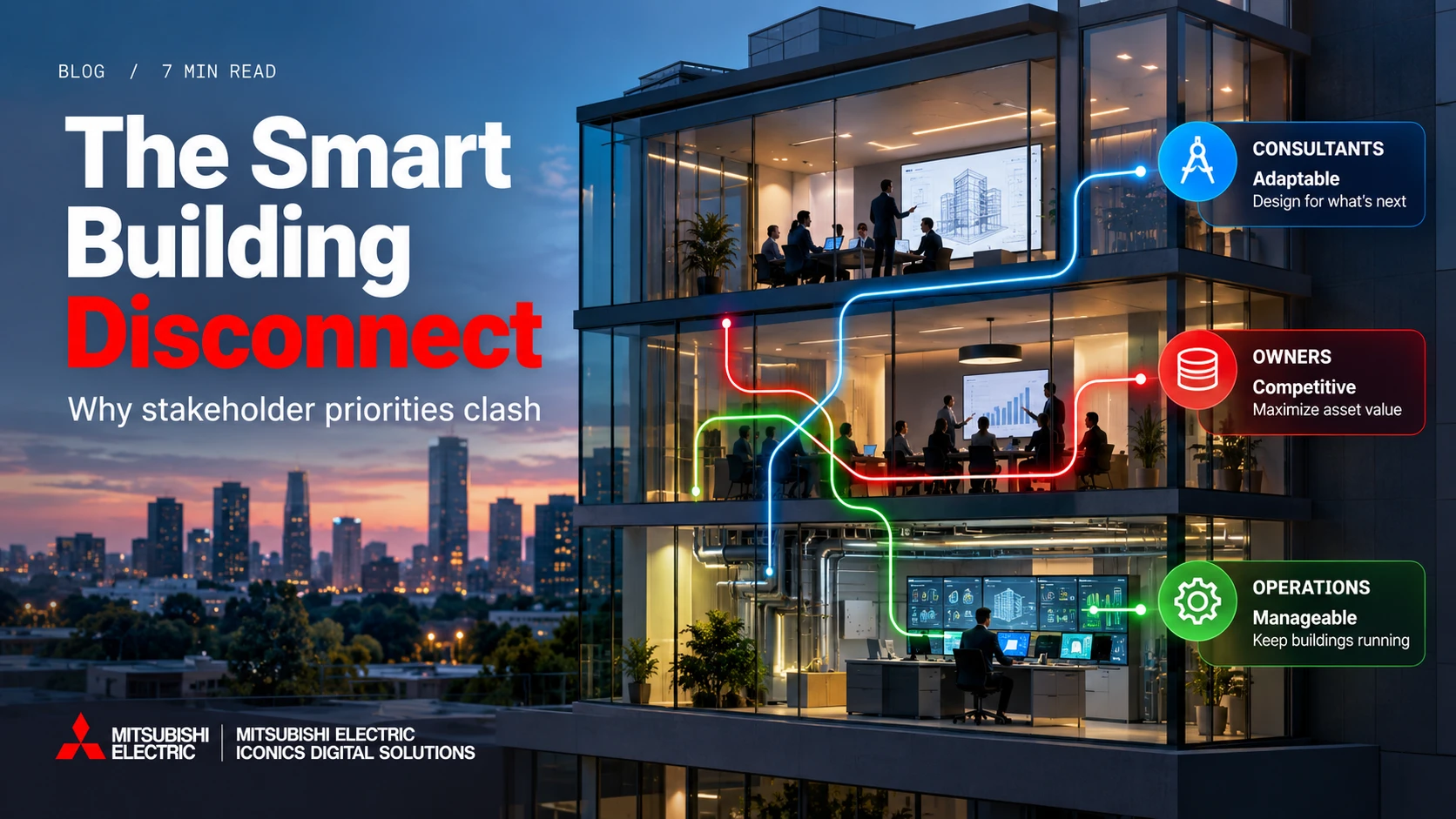
The smart building industry has a language problem. Consultants talk about interoperability. Owners talk about asset value. Facilities teams talk about workloads. Yet all three are often trying to solve the same problem.
As smart building investment matures, an interesting divide is emerging:
- Consultants specifying technology are focused on future flexibility.
- Owners funding technology are focused on commercial performance.
- Operators managing technology simply want buildings that are easier to run.
Many smart building projects struggle not only because of technology, but also because the stakeholders involved are working towards different definitions of success. That disconnect may be one of the biggest barriers preventing smart building programs from delivering their full potential.
One Building, Three Definitions of Success
A challenge frequently encountered in smart building initiatives is that different stakeholders enter the conversation with different priorities.
For consultants, success often means creating a building that can adapt to changing business requirements over the next decade. Their focus is typically on:
- Integration strategy
- Open standards
- Cybersecurity
- Technology resilience
- Future flexibility
Building owners are under pressure to improve the performance of the asset itself. Their priorities are more likely to include:
- Tenant attraction and retention
- Asset value
- Occupancy performance
- Operating costs
- Investment returns
Facilities and operations teams see the challenge differently. Their key questions include:
- Will it reduce reactive maintenance?
- Will it simplify operations?
- Will people actually use it?
- Will it create more work or remove it?
None of these perspectives are wrong. The challenge is that these priorities don’t naturally align.
In a recent conversation about a smart building project, the consultant's primary concern was ensuring flexibility for future occupier requirements. The building owner was focused on investment justification and asset competitiveness, while the operations team wanted clarity on how additional technology would affect day-to-day workloads.
Although their priorities differed, all three groups were ultimately trying to achieve the same outcome: a building that remains adaptable, commercially attractive, and operationally efficient throughout its lifecycle.
A well-designed smart building solution can help bridge these priorities.
For consultants, the solution provides the open, scalable foundation needed to support future occupier and technology requirements.
For owners, the solution delivers the data, insights, and flexibility needed to protect asset value, improve performance, and justify investment decisions.
For operations teams, the solution simplifies access to information, automates manual processes, and enables more proactive management of the building.
Viewed this way, the solution is not simply another technology layer, but a common thread that aligns technical, commercial and operational objectives around a shared goal of creating a higher-performing, future-ready asset.
Why Consultants Are Gaining Influence
The role of the smart building consultant has evolved significantly. A decade ago, consultants were often brought in to help specify systems and technologies. Today, many are helping shape broader digital, sustainability, and workplace strategies.
Topics such as environmental, social and governance (ESG), workplace experience, operational resilience, and portfolio optimization now sit alongside traditional building technology discussion.
For technology providers, understanding consultant priorities is becoming just as important as understanding the needs of building owners and operations teams.
Owners Are Facing a Different Reality
Building owners, meanwhile, face growing pressure in the commercial real estate market.
Hybrid working, rising operating costs, sustainability requirements and changing occupier expectations are forcing owners to reassess what makes a building competitive.
Research from JLL highlights a widening gap between assets that meet evolving occupier expectations and those at risk of becoming obsolete. The report notes that occupiers increasingly look for environments that support productivity, wellbeing and business performance, while investors are prioritizing assets that can respond to changing market conditions and future demands.
Against this backdrop, the conversation around smart buildings is changing.
Not: “What smart technologies should we install?”
But: “How does this help make the asset more competitive?”
That shift changes the entire conversation.
The Forgotten Stakeholder
In many smart building programs, consultants develop the technology strategy, and building owners approve the investment, often with limited input from the operations teams responsible for managing the building.
Yet operational success is rarely guaranteed simply because a system was well specified or approved within budget. Building teams ultimately determine whether technology becomes embedded into daily operations or remains an underused feature on a project close-out document.
The gap between strategic intent and operational reality remains one of the industry's most persistent challenges.
Stakeholder Alignment Before Technology
Similar themes emerged during our recent PropTech Connect 2026 roundtable discussion, The High-Performance Office, where participants repeatedly highlighted the challenge of aligning operational requirements, investment decisions, and measurable business outcomes.
The strongest smart building programs tend to have one thing in common: alignment.
Rather than starting with products, solutions, or procurement exercises, project stakeholders begin with a shared understanding of success. Establishing that understanding requires answering four key questions:
- What business problems are we trying to solve?
- What outcomes does the building owner want to achieve?
- What risks are consultants trying to mitigate?
- What challenges does the operations team need to address?
These questions often create more value than lengthy discussions about technology itself.
When commercial, technical, and operational objectives are aligned from the outset, investment decisions become clearer, adoption improves, and outcomes become easier to measure.
The Debate the Smart Building Industry Should Be Having
The smart building sector spends a great deal of time discussing technology: artificial intelligence (AI), digital twins, building operating systems (BOS), workplace apps, and sensors.
Yet project success depends on more than the technology itself.
These projects succeed because the people involved are working towards a shared objective or fail because they are not.
- Consultants want a building that remains adaptable.
- Owners want a building that remains competitive.
- Operators want a building that remains manageable.
The challenge is that those goals are often discussed separately, despite being closely connected. Perhaps the industry's biggest obstacle is not a lack of innovation, funding, or capability, but a lack of alignment.
Before organisations can agree on which technologies to deploy, they first need to agree on the outcome they are trying to achieve. Only then can consultants, owners and operators start speaking the same language.
And perhaps that is what a truly smart building should be designed to do: align people as effectively as it connects systems.
Let's Talk About Your Smart Building Goals
Looking to align your building's technology investments with commercial and operational objectives? Our smart building experts can help you explore solutions that support your priorities.
Speak to a Smart Building Expert
Frequently Asked Questions About Smart Building Success
Successful smart building projects depend on more than connected technologies. The following questions explore how consultants, building owners and operations teams can align their priorities to support long-term building performance.
What makes a smart building project successful?
A successful smart building project delivers measurable value for the people who design, own and operate the building. Success depends on aligning technical requirements, commercial objectives, and operational needs so that technology investments support long-term performance, adaptability, and efficiency.
Why is stakeholder alignment important in smart building projects?
Stakeholder alignment ensures that consultants, owners, and operations teams work towards shared objectives rather than competing priorities. Establishing common goals early helps guide technology decisions, reduce misunderstandings, and improve the likelihood of successful adoption.
What role do smart building consultants play?
Smart building consultants help define integration strategies, technical requirements, and long-term technology considerations. Their priorities often include interoperability, cybersecurity, resilience, and flexibility to accommodate changing occupier and business needs.
What do building owners expect from smart building investments?
Building owners typically focus on commercial outcomes, including asset value, tenant attraction and retention, occupancy performance, operating costs, and investment returns. Smart building investments should support these objectives while helping assets remain competitive as market requirements evolve.
Why should facilities and operations teams be involved early in smart building planning?
Facilities and operations teams are responsible for using and managing building technologies after implementation. Their involvement helps ensure that solutions address practical requirements, simplify workflows, and support more proactive building management rather than introducing unnecessary complexity.
How can smart building stakeholders align their priorities?
Stakeholders should begin by agreeing on the business problems they want to solve, the outcomes they expect, and the operational challenges they need to address. Shared objectives provide a foundation for evaluating technologies and measuring success throughout the building lifecycle.

Written By:
Recent Posts
What Is a Data Historian in OT? Definition, Architecture, and Applications

What Is a Digital Workplace? Definition, Components, and Benefits
The High-Performance Office: Turning Data, AI and Smart Tech into Measurable Asset Value
Why Master Systems Integrators and Digital Enablement Decide Whether a “Smart” Building Is Actually Smart
The Swim Isn't the Race: Are We Looking at Only Part of AI's Impact?