 English
 Czech
Czech
 German
 French
 Italian
 Japanese
 Polish
 Spanish
Category: Utilities and Energy , Building Automation
Federation Tower/ARMO Group

Moscow, Russia

Category: Utilities and Energy , Building Automation
Moscow, Russia
The Federation Tower in Moscow, Russia is to become the tallest building in Europe, as well as Europe’s first “Supertall” building. The complex is divided into two towers with a shared podium with a combined floor area of 423,000 square meters. Tower 1 is 360 meters and 93 stories tall with 207,000 square meters of floor space and is to be used primarily as office space. Tower 2 is 242 meters and 62 stories tall with 110,500 square meters of floor space and will be used as a hotel and residential apartments.
At the top of both towers, there will be a 360º-view observation deck and restaurant. Eight above-ground floors and one underground floor will contain over 50,000 square meters of shopping space. When completed, the complex will feature the world’s tallest spire, soaring up to over 506 meters and will have the world’s highest glass elevators, ascending at a rate of 18 meters per second. The building automation and security systems in the West Tower are being handled by the ARMO Group, a building systems, automation and management firm also located in Moscow.
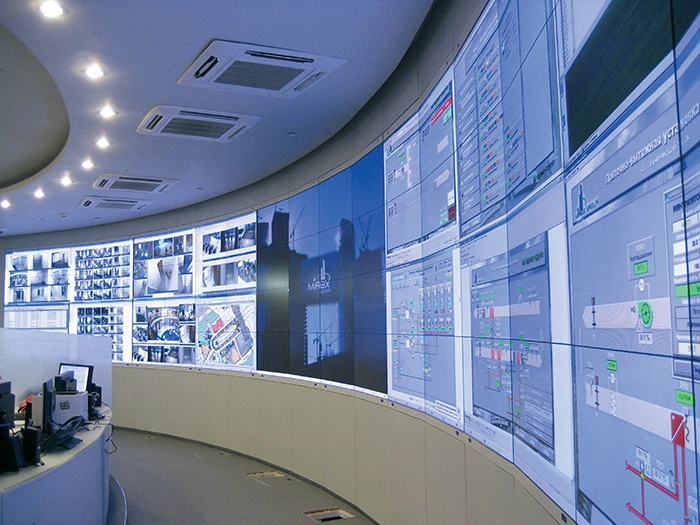 HMI/SCADA In Action at the Federation Tower (West)
Construction on the Federation Tower began in 2005 and will be complete in 2013. ARMO Group is assisting with the JCI Energy Smart Buildings and automation network in the West Tower, handling over 21,000 data points spread amongst 1,600 automated devices and using more than 20 digital integrations.
Among the systems now integrated with JCI M5 (Mitsubishi Electric Iconics Digital Solutions' GENESIS) are HVAC, Water Supply, Cooling Center, Heating Center, Electrical Transformer Substations, Electrical Distribution System, Uninterruptible Power Supplies, Diesel Generators, Fire Alarm System, Lighting Control, Elevators, Apartment/Room Control, Common Area Microclimate, and Central Dispatching Room.
Presently, the project encompasses over 41MVA of electrical power, 5.7 and 3.8MVA of backup DGU power, 35MW of cooling and 42.5 Gigacalories of heating. Over 40 JCI Network Controllers (NCMs) are utilized along with over 300 Echelon Lonworks® Field Level Controllers. There are seven stationary building control/automation management workstations throughout the West Tower as well as two portable workstations. All workstations in the Central Dispatching Room are connected to a multi-functional video wall, consisting of 96 high-contrast plasma panels. Throughout the year, all information about trends, alarm lists, access lists, etc., is archived to two clustered servers for network storage and can be accessed online at any time based on access permissions. Among the protocols used throughout the network are LonWorks, N2 Open, Modbus and BACnet. In fact, the JCI-networked West Tower is able to communicate with the Sauter-networked East Tower via BACnet integration.
HMI/SCADA In Action at the Federation Tower (West)
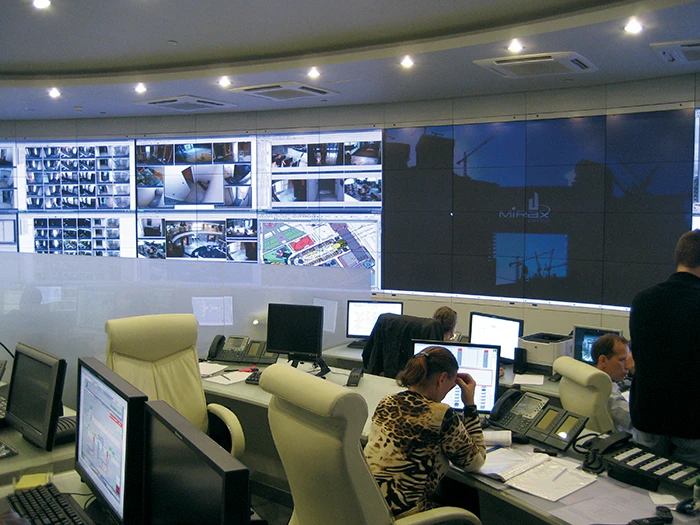 The Building Control Center Inside the Federation Tower (West)
The JCI M5 Workstation OEM version of Mitsubishi Electric Iconics Digital Solutions' GENESIS HMI/SCADA suite provides multiple benefits including scalability as the system grows, wide integration (via BACnet, OPC, etc.), enhanced graphic visualization, Web accessibility, and more.
The Building Control Center Inside the Federation Tower (West)
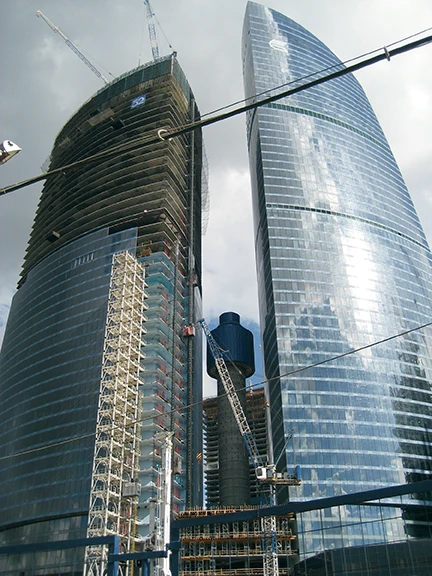 The Federation Tower Under Construction in Moscow, Russia
GENESIS provides the ARMO Group with a solution that include:
The Federation Tower Under Construction in Moscow, Russia
The group managing the Federation Tower is planning on upgrading their building management system, increasing to 50,000 data points, easily manageable with JCI M5 (Mitsubishi Electric Iconics Digital Solutions' GENESIS).