English
 Czech
Czech
 German
 French
 Italian
 Japanese
 Polish
 Spanish
 11 min read
Key Takeaways
- Start with business outcomes, not technology. Define the commercial and operational decisions you want to improve before investing in new smart-building technologies.
- Build digital foundations that can evolve. Open, interoperable infrastructure, accessible data, and consistent asset information help protect long-term flexibility as technologies and requirements change.
- Measure value beyond energy savings. Space utilization, maintenance efficiency, downtime, tenant experience, retention, and resilience all contribute to the business case for a high-performance office.
- Turn building intelligence into operational action. Data and insights only create value when operational teams have the skills, resources, and authority to act on them.
- Use AI to support informed decisions while retaining human accountability. AI can accelerate diagnosis, pattern recognition, and access to complex building data, but people remain responsible for critical operational, safety, compliance, and investment decisions.
Smart Technology Is No Longer the Differentiator
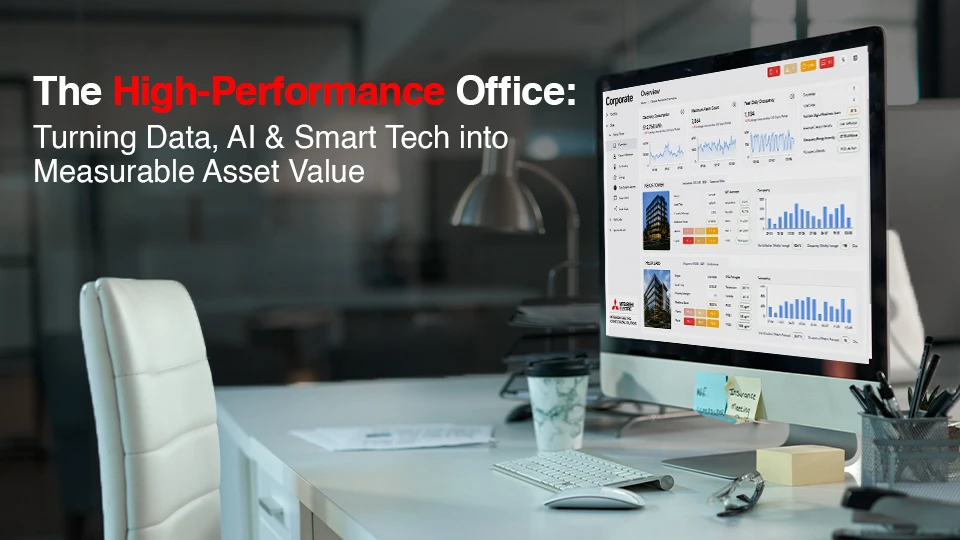
What turns a smart office into a high-performance office? More technology isn't necessarily the answer.
At PropTech Connect 2026, a roundtable discussion led by Jon Cook, Business Development Manager at Mitsubishi Electric Iconics Digital Solutions, brought together industry professionals to explore how data, AI and smart technology can translate into measurable asset value.
While perspectives differed on some questions, a clear consensus emerged: technology alone is no longer the differentiator. Value comes from having the right digital foundations, reliable and accessible data, fit-for-purpose operational models, and people capable of acting on the insights produced. Just as importantly, smart-building investments need to connect to clear commercial and operational objectives from the outset.
That distinction matters as capabilities once associated with premium smart buildings increasingly become expected. Sustainability, occupant comfort, and efficient building operation remain important, but attention is expanding to outcomes such as better space utilization, faster fault resolution, tenant experience, retention, and operational resilience.
The challenge, then, is no longer simply making buildings smarter but rather turning building intelligence into more informed decisions, stronger operational performance, and measurable asset value. That starts with a more fundamental question: Which commercial and operational outcomes should your smart-building investments improve?
Start With the Business Outcome, Not the Technology
The smart-building conversation can easily begin with technology: AI, IoT, digital twins, analytics, and the latest connected systems. But starting with a technology instead of the business outcome it needs to support risks creating sophisticated capabilities without a clear path to value.
A better starting point is to identify the commercial and operational outcomes the building needs to deliver. That could mean reducing downtime, improving space utilization, resolving faults faster, supporting tenant retention, or making maintenance more proactive. Once those outcomes are clear, organisations can define the use cases, data and technology needed to support them.
More data does not automatically lead to better decisions either. Collecting information simply because a building can generate it adds complexity if nobody knows how the data will be used. Each use case should connect data to a decision or action and, ultimately, to an outcome that matters to the organization.
The same principle applies to technology integration. A new solution may perform its individual function extremely well, but if it cannot exchange data with the wider building ecosystem, it risks becoming another silo. Starting with the outcome helps shift the conversation from “What technology should we deploy?” to “What capabilities do we need to achieve the outcomes we have defined?”
Once those outcomes are established, the next priority is creating a digital foundation capable of supporting them today and adapting as technology evolves.
Future-Proof the Digital Foundation, Not Every Technology
Buildings and technology operate on very different timelines. An office may remain in use for decades, while the technologies within it will change many times. Trying to select individual products today that will meet every future requirement is therefore unrealistic.
A more resilient approach is to create a digital foundation that allows the building to evolve. Open protocols, interoperable infrastructure, and accessible data make it easier to integrate new systems, replace technologies, and introduce new capabilities without rebuilding the digital environment around them. Building owners should also retain access to their data as products and vendors change.
Consistency matters as well. Standardized naming conventions, asset identification and historical datasets can create a stronger operational “golden thread,” helping teams understand how assets and systems perform over time. Reliable, well-structured data also provides a stronger foundation for analytics and AI.
This approach reduces another long-term risk: vendor lock-in. Proprietary technologies that restrict access to data or make integration difficult can limit an organization’s ability to adopt better solutions as needs change. Future-readiness depends less on predicting which technology will come next and more on ensuring the building can accommodate it.
A smart-building platform can provide this foundation by connecting and contextualizing data from operational technology, workplace systems, and business applications within a unified environment. By bringing previously siloed information together, organizations can gain a more consistent view of building and portfolio performance while creating a flexible data foundation for new technologies, analytics and AI.
Future-proofing starts with a flexible digital foundation that allows the organization to adopt new technologies and capabilities as requirements evolve.
Measure Value Beyond Energy Savings
Energy efficiency and sustainability remain fundamental measures of building performance but no longer tell the whole story. As these capabilities increasingly become expected, the business case for a high-performance office needs to consider a broader range of operational and commercial outcomes.
Better use of building data can help organisations understand how space is actually being used, identify faults sooner, reduce downtime, and move from reactive to more proactive maintenance. Building intelligence can also support decisions that affect occupant experience, tenant retention, and operational resilience.
Depending on the business outcomes defined at the outset, measurable value could include:
- Lower energy consumption and operating costs
- Better space utilization
- Faster fault resolution and less downtime
- More efficient and proactive maintenance
- Improved tenant experience and retention
- Longer lease periods
- Greater operational resilience
These measures provide a broader view of performance than energy savings alone and help connect building intelligence to outcomes that matter commercially and operationally.
At the same time, claims about asset value need to be made carefully. Roundtable participants did not reach a consensus that smart-building technology itself commands a distinct investment premium. Location, supply, building specification and leasing conditions can all influence rents and capital value, making the contribution of technology difficult to isolate.
Measurable asset value comes from what building intelligence enables an organization to achieve, and the operational and commercial outcomes that follow. Yet even the best data and clearly defined measures of value mean little if the building's operating model prevents people from acting on them.
The Missing Link Between Smart Buildings and High Performance Is Operations
A building can be designed with sophisticated technology, connected systems, and advanced analytics and still fail to deliver the performance envisioned during design. One of the strongest points of agreement from the roundtable was that the gap often appears after handover, when digital capability meets the realities of day-to-day building operations.
Facilities management models may be structured around cost, utilization targets, and contractual compliance rather than continuous performance improvement. Under those conditions, even valuable building intelligence can go unused. A system may identify an emerging fault, for example, but the insight creates little value if the engineer lacks the time, resources or authority to investigate and address it before a failure occurs.
The same challenge applies to service contracts. If maintenance, cleaning, and other services operate according to fixed schedules and traditional performance measures, access to more actionable data does not automatically translate into improved performance. Contracts and resourcing models need enough flexibility to allow building intelligence to influence when and where interventions occur.
Compliance alone is not enough either. Meeting a standard or completing a required check can demonstrate that a process has been followed, but high performance depends on what happens continuously throughout the building's operation.
Building intelligence only creates operational value when people are able to act on it. Closing the gap between digital capability and operational capability is essential to turning a smart building into a high-performance one.
Smart-building platforms can help close that gap by bringing information from across building systems into a common operational view, making relevant data and insights more accessible to the teams responsible for acting on them.
As the volume and complexity of building data increase, AI offers new ways to help operational teams identify what matters and make better-informed decisions.
Use AI to Improve Decisions, Not Remove Accountability
As buildings generate more data, one of AI's most valuable roles may be helping people make sense of it. Rather than requiring operational teams to manually search through large volumes of information, AI and machine learning can help teams:
- Identify anomalies and emerging issues that might otherwise take much longer to detect.
- Recognize patterns and trends across building and equipment data to support diagnosis and fault-finding.
- Access complex building data more easily through natural-language interfaces that could allow users to query building management system (BMS) data conversationally.
For example, an engineer might ask about recurring temperature anomalies, unusual energy consumption, or equipment performance and use the response to investigate further.
But faster access to information does not remove the need for professional judgement. Building operations can involve safety, compliance, occupant wellbeing, and significant investment decisions. AI can support diagnosis, triage, and decision-making, but people still need to evaluate the information, understand the operational context, and remain accountable for the actions taken.
Data quality and governance become even more important as AI takes on a greater role. An AI system can only work with the information available to it, making reliable data, appropriate oversight and clear accountability essential foundations for responsible use.
The opportunity is to give people better tools to understand what is happening, identify what matters, and make better informed decisions.
Technology Creates Value Only When People Can Use It
Even the best technology, data, and AI will not improve building performance if the people responsible for day-to-day operations cannot use them effectively. Technology adoption is ultimately a people issue, and introducing new capabilities without addressing how teams work can limit the value those capabilities deliver.
Operational teams need to understand not only how to use new systems, but also why the systems are being introduced and how the new capabilities can make day-to-day operations more effective. Training should build both technical confidence and a common language around data and digital systems.
Teams also need the time, authority, and incentives to act on the intelligence available to them. Providing an engineer with better information about an emerging problem achieves little if existing processes, workloads or contractual requirements prevent that engineer from responding.
Trust matters too. Building data should be positioned as a tool for improving performance and supporting better decisions, rather than as a mechanism for monitoring or policing employees and suppliers. If teams view new technology as a threat rather than a resource, adoption becomes much more difficult.
Change management needs to begin before the technology is deployed. People, processes and technology need to evolve together if building intelligence is going to translate into sustained operational performance and measurable value.
The High-Performance Office Is a Smarter Operating Model
The roundtable began with a question about how data, AI, and smart technology can create measurable asset value. The discussion ultimately pointed to a broader answer: high performance depends on connecting technology to clear business outcomes and creating the digital, operational and human foundations needed to turn building intelligence into action.
Across the discussion, a broad consensus emerged:
- Start with defined use cases and business outcomes before selecting technology.
- Invest in open infrastructure, reliable data, and interoperability to create a flexible digital foundation.
- Treat operational performance after handover as part of the investment case, rather than an FM afterthought.
- Use AI to support diagnosis and more informed decision-making while retaining human accountability.
- Give operational teams the skills, time, and authority to act on the intelligence available to operational teams.
Not every question produced the same level of agreement. Participants differed on whether smart buildings can yet be shown to command a distinct investment premium. Some saw a connection between high-performing buildings, higher rents and greater value, while others pointed to the difficulty of separating the impact of technology from location, supply and wider market conditions.
Questions also remain around certification, regulation and how much data is genuinely useful, particularly when maintaining standards throughout operation can prove harder than achieving standards at launch.
The areas of disagreement reinforce the importance of demonstrating value through measurable results. Building intelligence earns a place in the investment case through measurable improvements in decision-making, operational performance, and commercial outcomes over time.
A high-performance office brings data, technology, AI and people together through a smarter operating model that creates measurable value throughout the asset lifecycle.
Turn Building Intelligence into Measurable Value
Every high-performance building starts with a clear understanding of the commercial and operational outcomes the organization wants to achieve.
Talk to our smart building experts about defining your commercial and operational outcomes and identifying the digital foundations, data and technologies needed to achieve those outcomes.
Frequently Asked Questions
The following questions address some of the key considerations for organisations seeking to turn smart-building technology, data and AI into measurable operational and commercial value.
What makes a smart office a high-performance office?
A high-performance office connects smart-building technology to clearly defined commercial and operational outcomes. Open and interoperable digital infrastructure, reliable data, effective operating models and skilled operational teams help turn building intelligence into measurable improvements in areas such as energy efficiency, space utilization, maintenance, tenant experience and operational resilience.
How should organisations approach smart-building technology investments?
Smart-building investments should begin with the business outcomes and use cases the organization wants to address. Defining those outcomes first helps determine which data, capabilities and technologies are needed and reduces the risk of deploying isolated technologies without a clear path to operational or commercial value.
Why are open and interoperable digital foundations important for smart buildings?
Open protocols, interoperable infrastructure and accessible building data allow organisations to integrate new systems and replace technologies as requirements change. Consistent asset identification, standardized naming, and historical data can also create a stronger operational foundation while reducing the long-term risks associated with proprietary systems and vendor lock-in.
How can AI support high-performance building operations?
AI and machine learning can help operational teams identify anomalies and trends, accelerate diagnosis, and simplify access to complex building data. Natural-language interfaces may also make BMS data easier to query. Human oversight remains essential for decisions involving safety, compliance and investment, supported by strong data quality, governance, and professional accountability.
How can organisations measure the value of smart-building investments?
Measurement should extend beyond energy savings to reflect the business outcomes established for the building. Relevant measures can include space utilization, maintenance efficiency, downtime, tenant experience, retention, lease length, operational savings, and resilience. The roundtable did not establish that smart-building technology alone creates a distinct investment premium, so measurable operational and commercial outcomes provide a stronger basis for demonstrating value.

Written By:
Recent Posts
What Is a Data Historian in OT? Definition, Architecture, and Applications

What Is a Digital Workplace? Definition, Components, and Benefits
Why Master Systems Integrators and Digital Enablement Decide Whether a “Smart” Building Is Actually Smart
The Swim Isn't the Race: Are We Looking at Only Part of AI's Impact?