English
 Czech
Czech
 German
 French
 Italian
 Japanese
 Polish
 Spanish
 10 min read

Key Takeaways
- A Master Systems Integrator does more than connect building systems. The MSI provides overarching accountability across technologies, trades and interfaces, helping ensure systems work together as one connected environment.
- Digital enablement needs to begin early. Decisions about integration, interoperability, data, cybersecurity and infrastructure made during delivery can determine whether a smart building achieves its intended outcomes.
- Open, independent digital foundations protect long-term flexibility. Converged networks, open standards and an independent data layer help owners avoid vendor lock-in and retain control of their building data.
- The right foundations create value beyond a single building. Consistent data standards, cybersecurity requirements and integration approaches allow owners to benchmark assets and introduce new technologies more efficiently across an estate or portfolio.
Why Smart Technology Alone Doesn't Make a Building Smart
A smart building doesn't become smart simply because the right technologies have been specified. Much of its value is won or lost during delivery, when decisions about integration, interoperability, data, cybersecurity and infrastructure determine whether those technologies can actually work together. That's where the Master Systems Integrator comes in.
“Master Systems Integrator" (MSI) has gone from niche jargon to a fixture in UK tenders and Division 25 specifications in a remarkably short time. The Royal Institute of British Architects (RIBA) gave the role formal standing in its 2024 Smart Building Overlay to the Plan of Work, naming the MSI alongside the Smart Building Specialist as a distinct party to appoint and coordinate.
But rapid adoption of a term tends to outrun shared understanding of it - and the industry admits as much. One widely read piece put it bluntly: to date the MSI has been one of those terms that can mean all things to all people, and that lack of clarity breeds understandable hesitancy about the whole concept.
So, with one of our certified and preferred MSI partners Operational Intelligence, we want to cut through the noise and think about: what an MSI is and what an MSI actually does, why the role matters more than the label suggests, and why the quality of digital enablement during delivery is where the value of a smart building is quietly won or lost.
What an MSI Actually Is
RIBA's own glossary is a good starting point: an MSI makes sure all systems communicate properly, collaborates with building owners to ensure systems information is accessible and usable, and develops the software layers responsible for integration, aggregation and communication across the building's systems.
On more complex projects, that means connecting all the building systems on a converged network, implementing the interoperability use cases and coordinating between all the trades - working with the mechanical, electrical and security contractors, resolving IP addressing and cabling, and ensuring cybersecurity standards are met.
The industry analyst Verdantix draws a sharp and useful line here. In its Strategic Focus on the role of MSIs, it distinguishes smart building consultants - who typically provide "soft" advisory services like identifying use cases, reviewing existing systems and managing providers - from MSIs, who provide those advisory services in conjunction with the actual systems and software integration needed to make all the building's disparate technologies work as one across the whole life cycle.
Put simply: consultants advise; MSIs advise and implement. That implementation capability is the core differentiator, and it's why Verdantix finds MSIs commonly offer the hands-on services that consultants only partially cover: integrating disparate technologies, commissioning the BMS, building custom interfaces, running penetration testing, integrating siloed point solutions into a converged network.
The distinction we'd stress is that a genuine MSI is not a co-ordinator pulling together kit against a consultant's spec. Too often that thin version leaves owners paying a great deal but realising very few of their desired outcomes.
The gaps between individual packages are often where integration problems arise. The BMS, access control, lifts, lighting and network providers can all deliver their individual scopes correctly while nobody owns the interfaces between them. The MSI provides that overarching accountability - defining responsibilities, managing interfaces and resolving gaps so the overall connected outcome does not become the client's integration risk.
The MSI should instead be in the loop from the early stages of a build right through to operation and beyond, with deep expertise spanning physical connectivity, the OT and IT systems, the integration layer and the apps. While enterprise networking is about connectivity, the MSI's real job is orchestrating connected systems to work together intelligently - ensuring the building is not just connected, but truly intelligent.
Integration has to be proven, not assumed. Connecting systems is only part of the job. A good MSI defines acceptance criteria early, coordinates integration testing, and validates the agreed use cases end-to-end before handover. This ensures data, alarms, commands and workflows operate as intended before the building moves into operation.
That value shows up at every stage of the lifecycle, not just at the integration event.
Why Digital Enablement in Delivery Is Where Value Is Won or Lost
The uncomfortable truth is that the smartest technology underperforms if the digital foundations are laid badly during delivery. RIBA's overlay makes the same point structurally: its consistent industry feedback is that smart building designers are brought into concept design too late, as an afterthought, too late to shape client aspirations into deliverable outcomes.
The Digital Buildings Council's "lessons learned" work - drawing on MSI contractors across live UK projects - names late integration decisions and late MSI engagement as two of the six recurring failure modes on smart building projects.
Why does early digital enablement pay off so decisively? A few concrete reasons:
- Retrofitting integration is expensive and disruptive. Without an MSI overseeing the early phases, it's hard to plan the smart infrastructure in tandem with the construction programme - and if integration problems surface late, the fix can blow the budget and render the intended efficiencies undeliverable. Verdantix frames this as the value of the MSI acting as an overseer from the strategic-definition stage onwards, ensuring key elements of connectivity aren't inadvertently overlooked or value-engineered out of a project during planning.
- Handover is where data quietly haemorrhages. Verdantix cites NIST research that roughly a third of design and construction data is lost during handover - yet that information, from the materials used to the equipment installed, is exactly what owners and sustainability directors need for long-term operation and decarbonisation. Because MSIs and consultants typically engage early, they're well placed to protect the quality of the BIM and digital-twin data, so the information actually required for the operational phase is present when the building is handed over.
- Cybersecurity has to be designed in, not patched on. Verdantix is explicit that IT-OT convergence introduces additional security threats as OT systems increasingly sit on IP networks, and that a core MSI service is identifying the gaps and weaknesses, so each system and its integration is cyber-safe. RIBA operationalises this by putting a Built Asset Security Strategy and an Information Security approach (aligned to ISO 19650-5) as early as Concept Design. That matters because older building protocols like BACnet and Modbus predate encryption and authentication, and one study found three-quarters of organisations have building-management devices with known exploited vulnerabilities.
- The window to decide closes. Because smart technology iterates far faster than the building fabric, RIBA advises deferring final hardware and software selection to the latest practicable point - Stage 4 - while designing in the physical and system capacity to allow it. Get the enablement foundations right and you keep that flexibility; get them wrong and you've foreclosed options before anyone has moved in.
Preventing Vendor Lock-In at Every Layer of the Stack
Lock-in is rarely one decision. It's a series of small ones taken quietly across the stack. Proprietary protocols are maintained by a single vendor and typically require that vendor's gateway hardware, whereas open standards support multi-vendor implementations - and the trade-off is real, because proprietary extensions can deliver advanced features at the cost of that lock-in. A good MSI helps you make that trade deliberately rather than by accident.
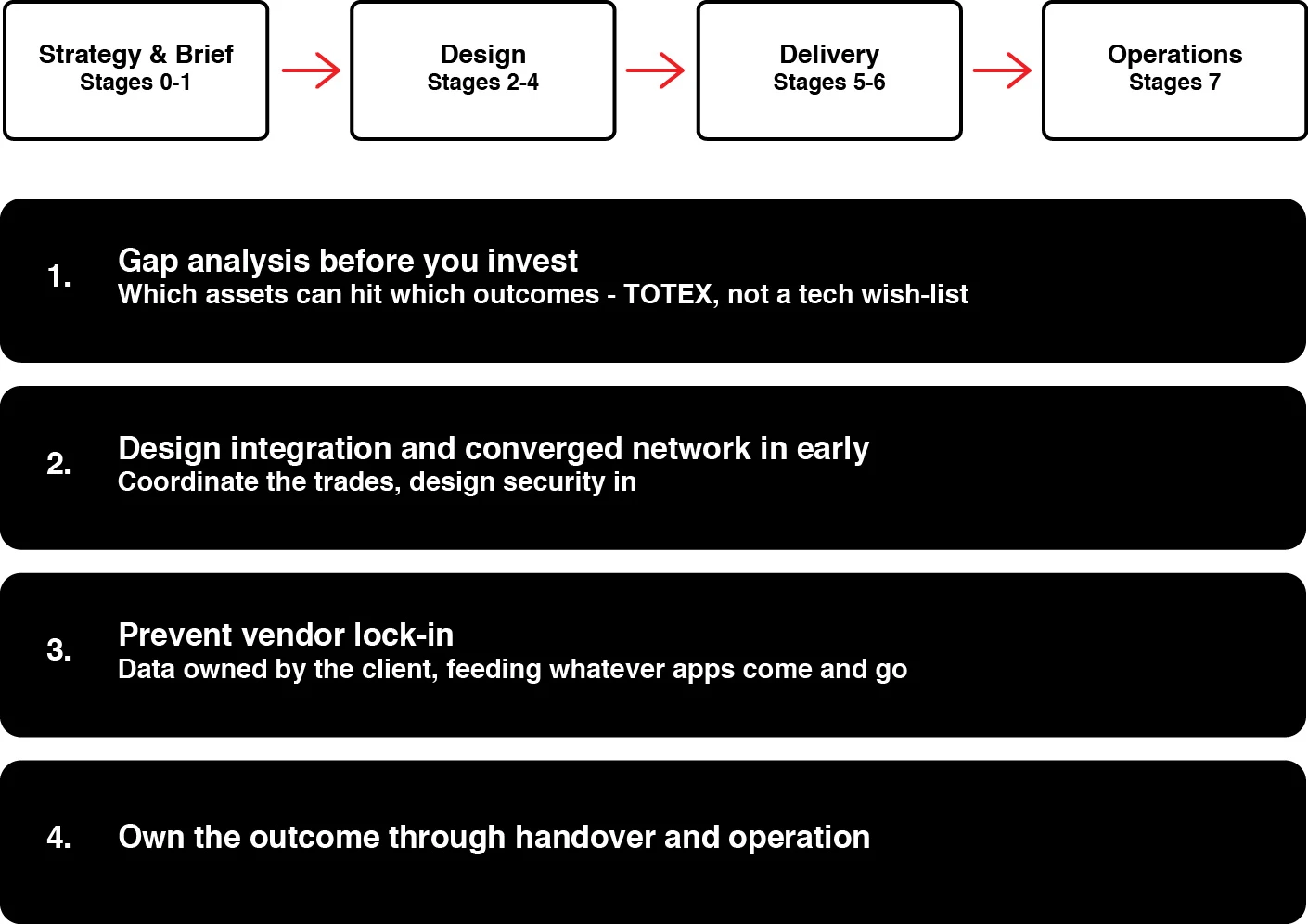
Verdantix's framing of the MSI's procurement role is instructive here: MSIs review the different standards in play to ensure systems can actually speak to one another, evaluate software APIs and the communication protocols supported, and check compatibility with the OT systems before anything is bought. That gatekeeping at procurement is one of the strongest defences against accidental lock-in - and it's a service Verdantix finds consultants typically only offer partially, because they don't carry the integration responsibility through to delivery.
The most powerful remedy in RIBA's overlay is architectural, and it's the concept I'd most want landlords to take away: the independent data layer. RIBA contrasts a "dependent" data layer - where data sits in, and is potentially owned by, the system provider - with an "independent" one, where the data is retained on the client's own servers, democratised and secure, feeding whatever applications and systems come and go over the building's life.
Because suppliers, software and owners all change, designing that independence in early is what lets you swap a vendor or add an application later as a configuration change rather than a demolition job. Verdantix notes that a growing number of MSIs are now developing their own building operating systems and software layers - which makes an MSI's genuine independence a fair and important question to ask. An integrator who only ever recommends one stack is worth scrutinising; ideally, as Verdantix puts it, they should be independent enough to give you the best possible recommendation for your needs.
The Pillar I Think Is Most Under-Appreciated: Gap Analysis Before You Invest
The most valuable thing an MSI or specialist can do often happens before a penny is spent on new kit: honestly assessing which of your assets can realistically achieve which outcomes.
This is central to how Verdantix sees the role. They describe MSIs and consultants commonly being engaged in retrofit projects that begin with an audit of existing systems to identify improvement opportunities - distinguishing where legacy controls can be updated and advising on open systems so the building is ready for future upgrades. It also stresses a "whole-systems" approach: helping owners break out of siloed thinking (the reflex to chase LED swaps or HVAC setpoint tweaks in isolation) to see the interdependencies between systems and where the real gains lie.
The pain points Verdantix identifies for real estate executives are precisely the questions a good gap analysis answers:
- How do we navigate a confusing technology landscape?
- Can we access and use the data we already have?
- What does our existing technology stack actually support?
- Where are the improvement opportunities beyond the low-hanging fruit?
RIBA builds the same discipline into its earliest stages. Stage 0 asks whether a smart building even is the right way to meet the client's objectives and explicitly notes that some smart technologies won't return on investment for years while others pay back quickly and many times over - a whole-life-cost judgement, not a technology shopping list.
Stage 1 turns that into a total expenditure (TOTEX) conversation: estimating capital expenditure (CAPEX) and comparing operational costs with and without the technology, so the business case is grounded before commitment. Independent readiness assessments in the market work the same way - evaluating existing infrastructure against secure, open, normalised, interoperable and converged principles, then producing a gap report with budget guidance and upgrade recommendations tailored to each asset.
This discipline also guards against a subtle trap: chasing "smartness" as a feature checklist rather than an outcome. A technology-first mindset and a use-case-driven approach where specific technologies are prioritised over user needs can produce unsuitable solutions and limit long-term value. An outcome approach is much more favourable. A proper gap analysis keeps the conversation anchored to the outcomes that actually matter - carbon, cost, occupant experience, measured performance - and stops owners over-investing in assets that can't return it while under-investing in the ones that can.
Where It All Comes Together: The Building Operating System
Everything we've described - the converged network, the independent data layer, the freedom from lock-in, the outcomes anchored in a gap analysis - needs somewhere to live. That somewhere is the Building Operating System (BOS).
RIBA's own glossary describes the BOS well: it is the core software platform of all connected building solutions - the "middleware" that bridges the building equipment below and the external applications above. That position in the stack is the whole point.
The converged network moves the data; the BOS is what sits above it, normalising and contextualising that data through consistent schemas and tagging (Haystack, Brick, and the like) so that a sensor reading, a meter value and an access event can be understood, related and acted upon as one coherent picture rather than a dozen proprietary dialects.
The critical characteristic is that a modern BOS is edge-to-cloud. Not everything belongs in the cloud, and not everything belongs at the edge. Latency-sensitive control, resilience when the connection drops, and data sovereignty argue for processing at the edge; portfolio-level analytics, AI, cross-asset benchmarking and long-term storage argue for the cloud.
The value becomes even greater at estate or portfolio scale. Common data standards, naming conventions, cybersecurity requirements and integration approaches allow owners to operate and benchmark assets consistently. New technologies and applications can then be introduced across multiple buildings without having to recreate the integration strategy every time.
A BOS worth the name spans both - running interoperably with edge controllers and devices on one side and cloud services and applications on the other, so the client can place each workload where it genuinely belongs rather than where a single vendor's architecture forces it.
The BOS also makes the independent data layer real rather than aspirational. When the BOS owns the interoperability - speaking natively to the OT systems at the edge and to the analytics, digital-twin and reporting tools in the cloud - the client retains control of and access to its data, and applications can be added, replaced or changed without locking the client into a particular vendor. It is the difference between a building that merely has technology installed in it and one that can genuinely be operated, optimised and re-tooled across its whole life.
That is the real prize an MSI is there to deliver: not a collection of connected systems, but a coherent operating platform, edge-to-cloud, sitting above a converged network and open enough to talk to anything. Get that right in delivery, and everything else - the outcomes, the efficiencies, the flexibility, the decarbonisation - becomes achievable.
Get it wrong, and no amount of clever technology further up the stack will save the building.
Smart Buildings Need More Than Smart Technology
Done properly, the MSI is the party that holds the whole building's technology strategy together across its life - protecting your data, your security posture, and your freedom to change your mind. And the single biggest determinant of whether a smart building actually delivers is whether digital enablement was treated as a core delivery discipline from Stage 0, not bolted on at the end.
As RIBA's overlay puts it, most projects now carry some degree of smart building technology whether they plan for it or not - the only question is whether it's enabled deliberately.
Operational Intelligence at PropTech Connect 2026
At PropTech Connect 2026, we sat down with Glen Carpenter, Client Solution Manager, and Aaron Lim, Project Lead at Operational Intelligence, to discuss the future of smart buildings, AI, and the growing importance of turning building data into meaningful business outcomes.
In this interview, the team shares their insights on:
- Why building data must move beyond simply being collected and start driving measurable outcomes
- How AI is becoming increasingly embedded within building platforms and operations
- The challenges created by disconnected and siloed building systems
- The importance of taking an outcome-driven approach to technology and integration
- How smart buildings can improve tenant experiences, operational efficiency, and sustainability performance
- Emerging trends and technologies shaping the future of the built environment
They also discuss the role of integration, the importance of understanding business goals before selecting technology, and why data quality remains the foundation for successful AI adoption.
Recorded live at PropTech Connect 2026

Subscribe for more interviews, industry insights, and smart building thought leadership from across the PropTech sector.
Continue the Smart Building Conversation
These were exactly the conversations we had at PropTech Connect 2026. If you’re thinking about these issues too, or if you’d push back on any of this, we’d like to keep the conversation going. Get in touch with us.
Frequently Asked Questions
Here are answers to some of the most common questions about Master Systems Integrators and their role in delivering smart buildings.
What is a Master Systems Integrator (MSI)?
A Master Systems Integrator helps ensure that a building's different systems can communicate and work together. An MSI can provide both strategic guidance and hands-on integration, connecting systems, coordinating interfaces between trades and helping create a coherent digital environment across the building lifecycle.
What is the difference between a Master Systems Integrator and a smart building consultant?
A smart building consultant typically focuses on advisory services such as identifying use cases, reviewing existing systems and managing providers. An MSI can provide similar strategic guidance while also implementing the systems and software integration required to make disparate building technologies work together.
Why should an MSI be involved early in a smart building project?
Early involvement allows integration, interoperability, cybersecurity, infrastructure and data requirements to be considered before key design and procurement decisions are locked in. Late integration decisions can increase costs, restrict technology choices and make intended building outcomes harder to achieve.
How can an MSI help prevent vendor lock-in?
An MSI can assess protocols, APIs, standards and compatibility before technologies are purchased and help establish an architecture based on open standards and an independent data layer. That approach can make it easier to change suppliers or introduce new applications without rebuilding the underlying integration strategy.
How does an MSI support multiple buildings across an estate or portfolio?
Common data standards, naming conventions, cybersecurity requirements and integration approaches can help owners operate and benchmark buildings consistently. A shared digital foundation can also make it easier to introduce new technologies and applications across multiple assets without recreating the integration strategy for each building.

Written By:

Written By:
Recent Posts
What Is a Data Historian in OT? Definition, Architecture, and Applications

What Is a Digital Workplace? Definition, Components, and Benefits
The High-Performance Office: Turning Data, AI and Smart Tech into Measurable Asset Value
The Swim Isn't the Race: Are We Looking at Only Part of AI's Impact?

Water Utility Cybersecurity: Building Operational Resilience Through Integrated SCADA and Controls