English
 Czech
Czech
 German
 French
 Italian
 Japanese
 Polish
 Spanish
 6 min read
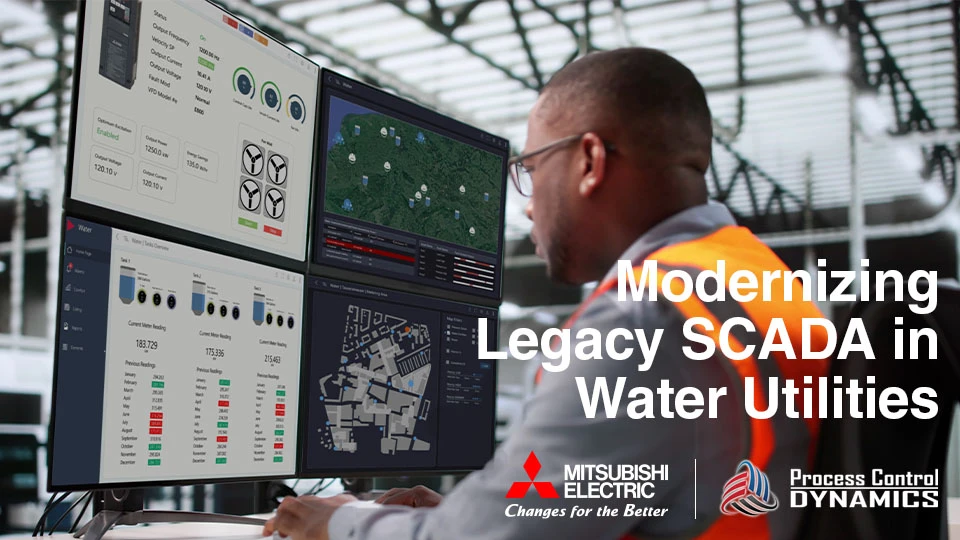
Guest blog by Kevin Jordan and Shawn Watson, Managing Partners and Owners, Process Control Dynamics, Inc.
Key Takeaways
- Water and wastewater operations are becoming more complex due to growing data volumes, regulatory requirements, and distributed infrastructure
- Legacy SCADA systems and fragmented assets limit visibility, increase workload, and introduce operational risk
- Mobility introduces additional challenges related to cybersecurity, data consistency, and access control
- Automation transforms manual reporting into continuous, reliable operational insight
- A unified modern SCADA platform improves visibility, reduces complexity, and supports more efficient and resilient operations
What It Really Takes to Run a Water Utility Today and How Technology Is Changing the Job
Running a water or wastewater system today often means working within a patchwork of legacy SCADA systems, disconnected assets, and evolving operational demands.
A typical day often begins with a SCADA dashboard, often one of several systems operators rely on to monitor alarms, flows, pressures, tank levels, and system status. From that point forward, work becomes a continuous cycle of monitoring performance, responding to issues, validating data, and planning maintenance, while ensuring systems remain operational 24/7.
As infrastructure ages and systems grow more complex, maintaining visibility, accuracy, and control across operations becomes increasingly difficult. As a result, operators must respond more quickly and make critical decisions with incomplete or fragmented information.
At the same time, technology is reshaping the role of the operator. Most utilities already rely on SCADA and related systems, but many of these environments are fragmented, aging, and not designed for today’s level of connectivity or data demand.
Modern platforms are transforming operations by moving from reactive monitoring across multiple systems to proactive management through unified, real-time insight. As a result, operators are shifting from manually navigating systems and validating data to overseeing performance through continuous, data-driven intelligence.
The Growing Complexity of Water Operations
Water and wastewater utilities face growing pressure to maintain performance while managing evolving operational and regulatory demands.
Several factors are driving this increasing complexity:
- Expanding data volumes and integrity challenges
Districts generate enormous volumes of process data. Capturing, storing, and presenting that data in a way that supports timely decisions remains a persistent challenge. Missing or incomplete data caused by outages or system limitations can impact both operations and compliance, making redundancy essential. - Evolving regulatory and cybersecurity requirements
Regulatory expectations continue to expand. Requirements tied to cybersecurity, including those introduced under the America’s Water Infrastructure Act (AWIA) of 2018, require utilities to implement and maintain comprehensive cybersecurity plans to protect critical infrastructure. - Ineffective alarm management strategies
Legacy alarm strategies often overwhelm operators with unnecessary notifications, a situation commonly described as the “Christmas tree effect.” When most operating conditions generate an alarm, identifying and responding to critical issues becomes more difficult. - Increased reliance on mobility and remote access
Mobility has become a standard expectation. Operators now access system data and controls from multiple devices across distributed locations, extending visibility beyond the control room.
However, this shift introduces new complexity. Expanding access points increases cybersecurity risk, requires consistent data synchronization across platforms, and demands careful control of user permissions to maintain operational integrity. Without a unified and secure approach, mobility can fragment visibility rather than improve it, adding another layer of operational risk.
Operational Impact: How Complexity Increases Risk, Workload, and Inefficiency
These pressures compound across daily operations. Operators must continuously:
- Monitor system performance across multiple assets and locations
- Respond to alarms and prioritize critical conditions
- Ensure regulatory compliance and reporting accuracy
- Manage maintenance activities and system reliability
Manual processes, fragmented data, and inconsistent visibility make each of these tasks more difficult, increasing workload and introducing risk.
As a result, response times slow and critical issues take longer to identify and resolve. Delays in detecting anomalies can impact system performance, increase downtime, and, in some cases, lead to compliance violations. At the same time, operators spend more time navigating systems and validating data rather than focusing on decision-making and system optimization.
Consequently, efficiency declines as effort increases. Operational teams must do more with the same resources, while system complexity continues to grow. Improving reliability, reducing operational burden, and simplifying system interaction has become essential.
From Fragmented Reporting to Automated Insight: Improving Accuracy, Efficiency, and Compliance
Most water utilities already rely on SCADA and related systems to support operations. However, reporting processes often remain fragmented and partially manual, especially when data must be pulled from multiple sources, validated, and reformatted before use.
As data volumes increase and regulatory requirements expand, these disconnected workflows introduce delays, inconsistency, and risk. Automation, when applied within a unified platform, changes this dynamic by transforming raw operational data into structured, validated, and actionable insight, delivered in real time or on demand.
The impact of this shift becomes clear in real-world applications.
Real-World Application: Reducing Compliance Reporting from Days to Hours
A Texas utility previously spent two full days each month compiling regulatory compliance reports. Teams were required to:
- Collect data from multiple systems
- Reformat information manually
- Verify results before submission
Each step introduced the potential for delay or error.
By implementing automated reporting with ReportWorX, the process was streamlined. Required data was captured directly from source systems. Formatting was applied automatically, and validation rules ensured consistency across reports.
Reporting time was reduced from two days to less than two hours. Beyond time savings, automation delivers measurable operational benefits:
- Improves data accuracy and consistency
- Strengthens compliance confidence
- Reduces operator workload
- Enables focus on monitoring, analysis, and response
As a result, reporting evolves from a fragmented, manual process into a continuous, reliable operational capability.
How Modern Platforms Support Water Operations
Addressing these challenges requires a unified technology approach to data, systems, and operations.
GENESIS, the SCADA automation and digitalization platform by Mitsubishi Electric Iconics Digital Solutions, provides real-time data acquisition, monitoring, control, and data management across water and wastewater environments.
A data-centric architecture ensures that operational data is captured, validated, and contextualized, while an integrated historian supports high-resolution data storage, reporting, and analysis.
A modern platform must support operations across multiple dimensions. GENESIS delivers:
- Reliable data capture and management through a data-centric architecture and integrated historian
- System resilience and continuity with built-in redundancy and high availability
- Effective alarm management that reduces noise and prioritizes critical conditions
- Secure mobile access that extends visibility and control beyond the control room
- Automated reporting that simplifies regulatory compliance and reduces manual effort
- Enterprise integration with CMMS, modeling, and asset management systems to support modernization without disruption
As a result, utilities gain improved visibility, stronger reliability, and more efficient operations across distributed systems.
Supporting the People Behind the Systems
Water and wastewater operations depend on the people responsible for keeping systems running. Technology must support that responsibility by reducing complexity, improving visibility, and enabling faster, more informed decisions.
When systems provide clear insight, reliable data, and consistent workflows, operators can focus on maintaining performance, ensuring compliance, and delivering uninterrupted service. In this environment, technology becomes an operational partner rather than an added burden.
Join the Conversation at Texas Water 2026
These operational realities are shaping conversations across the industry, and Mitsubishi Electric Iconics Digital Solutions will be present at Texas Water 2026, the largest regional water conference in the United States.
Taking place April 27–30, 2026, at the Henry B. González Convention Center in San Antonio, Texas, the event brings together thousands of water and wastewater professionals, including engineers, operators, regulators, and technology providers.
As the joint annual conference of the Water Environment Association of Texas (WEAT) and the Texas Section American Water Works Association (TAWWA), Texas Water offers a unique opportunity to:
- Explore current operational and regulatory challenges
- Share best practices with industry peers
- Evaluate emerging technologies and solutions
In addition, the event features:
- Technical sessions and operator-focused programs
- Networking opportunities across the water industry
- Industry discussions on data, cybersecurity, mobility, and operational efficiency
We will be attending Texas Water 2026. Visit booth 215; we welcome the opportunity to connect, discuss industry challenges, and share practical insights from real-world utility projects.
If your organization is navigating similar challenges, Texas Water 2026 provides an opportunity to engage with industry experts and explore how a modern, unified SCADA platform such as GENESIS can support more efficient and resilient operations.
Modernize Water Operations with GENESIS
Gain a deeper understanding of how a unified SCADA and data platform can simplify operations, improve reliability, and support compliance.
Download the GENESIS Water & Wastewater brochure to explore capabilities, real-world applications, and practical approaches to modernizing water operations.
About the Authors
Kevin Jordan and Shawn Watson are industry experts at Process Control Dynamics, Inc., a manufacturer’s representative for Mitsubishi Electric Iconics Digital Solutions. They advise water and wastewater utilities on automation and data management strategies and work closely with system integration partners to support implementation across the project lifecycle.

Written By:

Written By:
Recent Posts
What Is a Data Historian in OT? Definition, Architecture, and Applications
What Is a Digital Workplace? Definition, Components, and Benefits
The High-Performance Office: Turning Data, AI and Smart Tech into Measurable Asset Value
Why Master Systems Integrators and Digital Enablement Decide Whether a “Smart” Building Is Actually Smart