English
 Czech
Czech
 German
 French
 Italian
 Japanese
 Polish
 Spanish
 20 min read
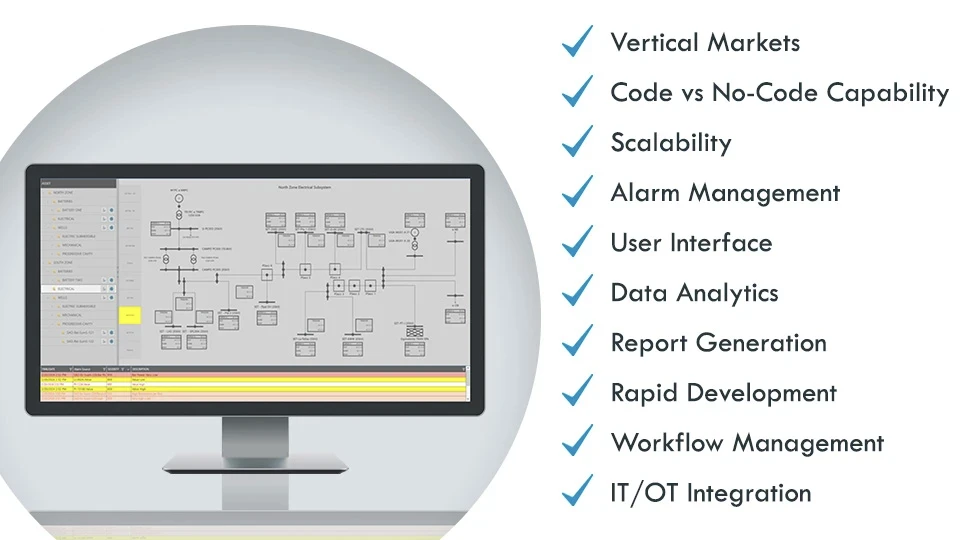
SCADA (Supervisory Control and Data Acquisition) je základní softwarové řešení pro řízení velkých procesů na mnoha vertikálních trzích průmyslové výroby a infastruktury a je také základní informační platformou pro Průmysl 4.0 a digitální transformaci.
SCADA hraje tradičně roli operátorského rozhraní pro velké, složité a distribuované systémy. Software SCADA se dnes stal natolik modulárním a škálovatelným, že se vyvinul ve výchozí platformu pro monitorování všech aspektů průmyslové automatizace, která organizacím pomáhá při neustálém zlepšování a optimalizaci procesů. Systém SCADA je ve skutečnosti klíčový pro maximalizaci OT a IT strategií pro analýzu a správu informací.
Mějte na paměti, že existuje mnoho možností, které je třeba zvážit při výběru softwaru SCADA. Všechny poskytují jedinečné výhody, ale i nevýhody a řešení, které si vyberete a budete s nimi pracovat po několik let (nejméně 10+ let). Především z tohoto důvodu je nesmírně důležité porozumět pokynům pro výběr softwaru SCADA.
Pokyny a rady pro výběr softwaru SCADA
Níže je uveden rozsáhlý seznam výběrových kritérií a tyto informace jsou klíčové pro informovaná rozhodnutí o vašem SCADA systému:
- Specializace na vertikální trh – má osvědčené výsledky jako SCADA řešení na navašem trhu.
- Schopnost Code vs No-Code – nabízí vývoj konfigurovatelných vs programovatelných aplikací.
- Škálovatelnost – Zvládá dnešní i budoucí požadavky.
- Správa alarmů – nabízí flexibilní alarmy a podporuje standardy alarmů.
- Archivace dat – obsahuje funkce pro ukládání dat, kompresi, načítání a právu místa na disku.
- Uživatelské rozhraní – poskytuje konzistentní uživatelské prostředí pro vizualizace napříč různými zařízeními a typy klientů, včetně těch pouze pro čtení, interaktivních, místních i vzdálených.
- Tag Management – obsahuje možnosti pro správu tagů - Flat Tag Model vs S95 vs UNS /Unifierd Namespace).
- Data Analytics – poskytuje nástroje pro vývoj a správu analytiky napříč doménami v reálném čase i napříč historickými doménami.
- Vytváření zpráv – poskytuje možnost automatického vykazování podle času a událostí.
- Oznámení – nabízí kapacitu pro email, SMS a další oznamovací prostředky.
- Rychlý vývoj – obsahuje časově úsporné nástroje pro nasazení a repliaci podobných funkcí - klonování, množení.
- Dokumentace aplikace – obsahuje dokumentační nástroje pro sestavování sestav.
- Workflow Management – Provides tools for managing multi-step processes.
- Recipe Management – Has the ability to set operating parameters based on system requirements.
- IT/OT Integration – Provides tools to read/write, display, and interact with relational databases.
- Trend Analytics – Delivers user tools for history data retrieval and analysis.
- Standards Support – Supports various industry standards (OPC, MQTT, FDA 21 CFR Part 11, ISA95, ISA18.2, etc.).
- Performance Speed & Management – Offers high transaction speed and tools for performance management.
- Reliability – Delivers 24x7x365 solution reliability.
- System Health Monitoring – Provides tools for monitoring operational performance.
- Redundancy – Supports high availability requirements.
- Northbound Protocol Connectivity – Provides client support through one or more standards or proprietary APIs and protocols.
- Southbound Protocol Connectivity – Delivers the required protocol(s) robustly and reliably.
- Flexibility – Contains features and benefits that are differentiators at a detail level.
- Distribution – Is available locally or internationally.
- Interoperability – Plays well with other applications.
- Operating System Support – Is supported on the operating systems important to you.
- Ease of Use – Is designed for user or programmatic configuration.
- Technical Support – Offers quality technical support and various program support types.
- Proven – Should be widely used in the market.
- Vendor Endorsed – Delivers protocol owner endorsement of the solution.
- Certifications – Meets protocol certification requirements.
- Price – Available as a cost competitive solution, especially when considering total cost of ownership (TCO).
- License Model – Offers a license model that fits your OpEx/CapEx budget.
Specializace na vertikální trh – SCADA si jako softwarové řešení získalo popularitu spolu se zavedením osobních počítačů v 70. letech 20. století. Dnes existuje široká škála softwarových řešení SCADA, ze kterých si můžete vybrat a SCADA se stala běžnou součástí každého vertikálního trhu průmyslové výroby a infrastruktury.
Mezi klíčové trhy, které vedly ke specializaci na software SCADA patří ropa a plyn, farmaceutický průmysl, potraviny a nápoje, automobilový průmysl, chemikálie, stavebnictví, automatizace továren, voda a odpadní vody, energetika a veřejné služby, doprava a výroba pro všeobecné účely všeho druhu.
Při procházení softwarových řešení SCADA věnujte zvláštní pozornost jedinečné funkčnosti, která může existovat pro vaši aplikaci na vertikálním trhu. Klíčovými oblastmi zaměření bude podpora vertikálních tržních standardů, komunikace se zařízeními a sady grafických symbolů či analýza jedinečná pro váš trh.
Schopnost code vs No-code – Dalším aspektem SCADA, který je třeba zvážit je, zda nabízí vývoj aplikací programovatelný (kód) konfigurovatelný (bez kódu), protože tato schopnost bude mít významný dopad jak na náklady na uvedení do provozu (náklady na spuštění), tak na celkové náklady vlastnictví řešení (dlouhodobé náklady na správu).
Uvedení do provozu se často provádí s odbornými znalostmi společnosti systémové integrace. Dlouhodobé řízení může být také řešeno systémovým integrátorem, ale často je řešeno interně nebo kombinací obou. Mnoho softwarových řešení SCADA je orientováno na vývojové prostředí, které poskytuje podporu pro mnoho základních požadavků aplikace a ponechává prostor pro jakékoli další požadavky, které mají být splněny prostřednictvím vlastního vývoje partnerem systémové integrace.
Vývoj softwaru na zakázku pro kódové SCADA řešení sice umožňuje dělat prakticky vše v automatizaci, ale činí tak za cenu dodatečného času na vývoj, zavedení větší složitosti a potřeby dalšího odstraňování problémů/ladění s průběžnou údržbou. Bez kódové SCADA řešení může být stejně flexibilní, zejména pokud má prodejce dlouhou historii v oboru a zavedené odborné znalosti. Konfigurovatelná řešení jsou pro koncové uživatele snazší přijmout a dlouhodobě podporovat.
Systémoví integrátoři mají často rádi kódová řešení, protože tyto typy SCADA jim dávají větší příležitost přizpůsobit a dodat jedinečné řešení, na jehož podpoře se budou s největší pravděpodobností podílet dlouhodobě. Na vyspělém trhu SCADA je téměř vždy lepší zvolit osvědčené a konfigurovatelné řešení bez kódu. Všechna řešení, ať už kódovaná nebo nekódovaná, nabízejí však možnosti přizpůsobení pro náročné aplikace.
Škálovatelnost – SCADA software je vybrán pro danou aplikaci a může být časem, možná v průběhu desítek let, vylepšován, aby mohl přijímat nové zdroje dat a zvládat nové požadavky. Software SCADA, který si vyberete by měl poskytovat flexibilní licencování a kvalitní podporu, která vám pomůže s dlouhodobým vlastnictvím aplikace.
Budete chtít zkontrolovat data vydání produktů, vylepšení funkcí atd., abyste se ujistili, že dodavatel softwaru SCADA aktivně investuje do řešení, takže společnost bude schopna v nadcházejících letech řešit a nadále řešit vaše potřeby.
Dále je také potřeba vzít v úvahu, že vaše aplikace může vyrůst z architektury jednoho serverového uzlu na síť mnoha uzlů. Prohlédněte si datovou architekturu softwaru SCADA, abyste pochopili, jak se k datům přistupuje v distribuovaném prostředí a jak snadné je přeměnit vaši architekturu na distribuci funkcí podle potřeby. To může znamenat přesun historizace nebo hlášení z jednoho serveru na jiný dedikovaný server pro lepší výkon. Software SCADA, který si vyberete by vám měl v těchto oblastech poskytnout flexibilitu.
Správa alarmů – All applications will benefit from alarm or event management. Some applications have greater demands on alarm management and may even require the support of alarm management standards such as ISA 18.2. Advanced features in alarming which include alarm shelving, alarm suppression, and alarm acknowledgements can become very complex.
Notification schemes should exist within your SCADA solution for you to select the proper users to notify or trigger workflows to manage alarm responses. Standards such as the OPC Foundation OPC UA A&C (Alarms and Conditions) are excellent in enabling compatibility with other software solutions in the market.
Archivace dat – Your SCADA of choice should include features for data storage, compression, retrieval, and disk space management. Data archiving, also known as data logging and the more sophisticated data historization, is an extremely important part of a serious SCADA software solution.
In smaller applications, data archiving may simply be accomplished by logging to files or to a relational database. In larger applications, performance will benefit from data compression techniques to minimize storage space and improve response times.
Many SCADA software solutions also offer data management tools to archive old data for memory management. Standards also play a significant role in data archiving. Ideally, archived data should be available for both IT and OT use. In the IT domain, relational database standards apply for data access.
In the OT space, standards such as the OPC Foundation OPC UA HDA (Historical Data Access) will play a vital role in the integration with other OT software solutions. Pay special attention to the OPC UA HDA aggregate functions as these are a major differentiator in how OT solutions can query for analytically reduced data sets.
Uživatelské rozhraní – With the advancement of internet graphics, every SCADA delivers a user interface. Most SCADA graphics are both scalable across mobile and desktop interfaces and are also fully web enabled. There has been a long history of graphic technologies and now virtually all SCADA software has caught up.
Some are still supporting legacy programming environments such as VBA (visual basic for application) while others are built on more modern tools for their different configuration environments. Users may use one tool to create web-based graphics and another for desktop graphics.
Obviously, the requirement for scripting tools in user interface design are not optimal. The ideal solution will offer a complete point-and-click solution for all user interface development. Tools should exist for data display and animations, etc.
A SCADA should also offer special objects for trends, alarm displays, data entry, relational data display, as well as a complete array of standard objects to match your vertical market. Some solutions offer 3D graphics animation, a capability that is at the forefront of user interface technology, so keep an eye out for these.
Tag Management – Tags are the names for variables in your system. Data is typically requested by using the tag name. Modern SCADA solutions offer very robust tag names with hierarchical organization into sites, areas, lines, equipment, etc. This capability is also known as an ISA S95 definition. Other systems refer to this as asset-based information modeling. Unified Name Space (UNS) is another concept for creating a directory of all tags and meta data associated with them.
In addition to organizing access to data through information modelling definitions, it is equally important for a SCADA to have the capability to apply analytics to these models to perform rapid and less error prone development.
Moreover, graphic objects should consume modelled data, and analytics should apply to modelled data. This is an area of active technology development with organizations such as CESMII and the OPC Foundation that drive the adoption of information models to enable Industry 4.0, digital transformation, and smart manufacturing.
Data Analytics – Data analytics is supported by all SCADA software solutions these days. Differentiators in this area include SCADAs that use templates, models for analytics, rules-based analytics, and workflows applied to analytics as solution accelerators. These SCADAs can also combine real-time analytics with analytics on both relational database and historian database sources.
Generování reportů – Report generation is often a requirement in SCADA applications. This is also an area of specialization, and few SCADA vendors offer high-quality reporting, typically deferring that capability to third-party technology providers.
A leading SCADA solution will offer good quality reporting with built-in tools, while also offering standards-based interfaces for third-party support, including relational database interface standards and OT standards such as OPC UA – DA (Data Access), HDA (History Data Access), A&C (Alarms and Conditions). OPC UA HDA aggregate functions are a key differentiator in accessing analytically reduced data sets for report generation.
Oznámení – Notifications are a powerful way to ensure users respond to anomalies quickly and efficiently. A SCADA’s capability in this area can be a major differentiator.
Some solutions offer good internal capabilities while some rely on custom software development. Still there are others that rely on third-party solution providers. Again, consider the SCADA support for both IT and OT data standards, which will be valuable in accessing the information to support notifications.
Rychlý vývoj – Most SCADA applications have a significant requirement for repetitive configuration tasks. The configuration work completed for one plant can apply to another plant, from one line to the next, and from one piece of equipment to another. Tools for the replication and automated modification of an application will greatly enhance the developer productivity and reduce the chance of errors.
These tools are often referred to as cloning or multiplication tools. Ideally, the SCADA software configuration will be stored in a standard format, perhaps a relational database. This capability greatly enhances the ability to rapidly deploy highly scalable applications.
Dokumentace aplikací – Generating application documentation is crucial for training/education and change management. The SCADA should be able to store its application configuration as a common format (files or relational database tables) and should contain documentation tools that translate application configurations into human readable forms.
Workflow Management – Most SCADA software solutions are designed for real-time operation – operator interfaces, alarm management, and analytics. Newer SCADA software solutions offer an additional focus on time-based or event-based decision trees and data integration from IT sources (relational data). Even more sophisticated SCADA software will manage workflows, take results from analytics or alarms, etc., and follow procedures for notification, distribution, etc.
Recipe Management – A recipe can mean different things to different users. We may think of recipes as packaged changes to go from manufacturing product A to manufacturing product B. But recipes can also be considered as a set of parameters to run in any particular state. For example, the alarm levels for operating at full load as opposed to operating at minimal load. A SCADA with recipe management can adjust conditions based on product or operational conditions, an essential manufacturing capability.
IT/OT Integration – SCADA software is bridging the IT and OT gap to deliver analytics across both domains. A top SCADA should offer high quality interfaces to be able to retrieve, analyze, and display data from relational database sources and traditional OT device sources.
The ability to integrate data from both the IT and OT domains is critical to accelerating a digital transformation. In addition, IT infrastructures are rich with security, performance, and reliability data, so the ability to tap into this information domain is critical to running the most reliable environment. The support for IT protocols such as SNMP should also be a standard feature of every SCADA software.
Trend Analytics – Data trending is one of the most powerful ways to understand your process, so a SCADA should provide user-friendly tools for historical data retrieval and analysis. The SCADA should offer tools for pre-defined trending as well as ad-hoc trending.
An advanced SCADA will also offer tools for highlighting data, adding comments, and exporting data for use in other analytic solutions. Collaborating on analyses and sharing results with others are also important, and modern trend tools can facilitate this.
Standards Support – Standards have never been more important. Today’s solutions are often integrations of best-in-class products. The support of industry standards ensures that products will share data efficiently and reliably. There are many standards in SCADA, both in technology and in support for vertical markets.
For technology, look for OPC Foundation support and OPC UA compliance. For vertical markets, look for 21 CFR Part 11 in FDA regulated markets. PackML is common in food and beverage applications. ISA 18.2 is common for alarm management in the process industries. There are also best practice guidelines around high performance operator graphics, delivering decluttered interfaces and progressive disclosure to improve operator performance. A modern SCADA will have support for all of these.
Performance Speed & Management – A top SCADA will have high transaction speed, display and analytics responsiveness, and performance management tools. The need to consider performance in a SCADA will vary greatly with the size and character of the application. Be aware of the application’s needs and be sure that your SCADA has health monitoring capability.
Reliability – A modern SCADA will deliver 24x7x365 reliability. Considerations need to apply to both fully functional operation and operation when some devices are offline. Consideration should also be given to communication line quality, for example error rates in wireless configurations. Quality device communications should adapt to these varying situations and recover automatically.
Redundancy – Investigate how a SCADA supports high availability requirements. SCADA often supports architectures for higher availability, and these may include redundant communications paths or complete SCADA server redundancy that is invisible to a client application. High availability may also rely on hardware platforms like those from Stratus or virtual machines.
Northbound Protocol Connectivity – A SCADA should provide client support through one or more standard or proprietary APIs. Most applications are becoming the integration of best-in-class software components. The support of communication standards will be critical to enabling this integration.
Look at the OPC versions that the SCADA supports. Options are OPC Classic versions of OPC DA, OPC A&E, OPC HDA and the newer OPC UA with support for data access (DA), alarms and conditions (A&C), and historical data access (HDA).
While OPC UA is a complete protocol with data structures and transport, there are newer forms of OPC UA based on the MQTT transport. Often, OPC servers will support a number of northbound APIs for use in different integration scenarios. Internet and IoT architectures benefit from publish/subscribe protocols such as MQTT and AMQP while SCADA architectures benefit from poll/response with reporting by exception. There are also proprietary protocols such as Suitelink and EDA (Easy Data Access) that support particular SCADA software solutions.
Southbound Protocol Connectivity – A SCADA should deliver robustness for your required protocol(s). Southbound connectivity offers communications, typically both read and write, to the devices in your automation system. The most common protocol in the industrial automation world is MODBUS, delivered back in 1979 as a serial protocol and now adapted over time to Ethernet.
In the IT domain, SNMP (Simple Network Management Protocol) is very common. In the power domain, there are protocols such as 61850 and DNP3. In oil and gas, many count on the reliable collection of electronic flow measurement (EFM) data as crucial to their operations. In building automation, there are BACnet and BACnet/SC.
Various markets and vendors have introduced protocols that are adapted to best support vertical markets and unique applications. The latest technology to consider is Ethernet with Time Series Networking (TSN) supported by an industry standard protocol called CC-Link IE TSN. Other industrial ethernet protocols include PROFINET, Ethernet/IP, and EtherCAT.
There are dozens of current day protocols and an equal number of legacy protocols that are supported by many different OPC server providers. Modern OPC servers will support more than one protocol at a time. These are often sold as individual drivers, bundles of protocols, or a complete suite.
Flexibility – At a detailed level, look at what features and benefits are differentiators in a SCADA. Flexibility in a SCADA can range greatly and becomes more important in larger or more demanding applications.
Flexibility may involve the support of non-standard architectures, runtime configuration, remote configuration, API-based configuration, the ability to import and export configurations, application documentation, and more. In small and simple applications, flexibility is not necessarily a differentiator, but in larger and more demanding applications, it can become a serious area of differentiation between SCADA software offerings.
Distribution – Be sure the SCADA is available locally or internationally. Check if the products are sold through distribution or direct and if the SCADA software solution is recommended or private-labeled by OEMs in the industry. These are factors to consider in comparing one offering to another in terms of market reputation. Bear in mind that most SCADAs allow you to download a trial for test purposes before purchase, so look for this.
Interoperability – A top SCADA plays well with other applications. The foundational requirement of a SCADA is typically to co-exist with other applications on one computer. This may require the tuning of priorities or the special allocation of computer resources. It may also require running different applications in virtual machines. You will want to make sure your SCADA of choice supports your system and IT security architectures.
Operating System Support – A SCADA should be supported on the operating systems important to you. In the world of industrial automation, the most common platform is Microsoft Windows. Linux is also becoming very popular and Docker equally so. You will want to make sure your OPC Server runs on both workstation and server configurations and in scenarios with virtual machines.
Ease of Use – A SCADA should be designed for user or programmatic configuration. The ease of configuration is also a major factor in the selection of a SCADA. Options for configuration include manual configuration through a set of configuration menus and selections; programmatic configuration through a set of APIs that enable the support of external tools to automatically generate a configuration; and application configurations that are often stored in easy to access file formats or databases. In many cases, tools for export and import are also available to support configuration and documentation in other software solutions, often Microsoft Excel.
Technical Support – A SCADA vendor should provide quality technical support and various support program types. Check if the SCADA provider is a long-term viable solution provider. Also check if there are regular releases of the SCADA software and if there are updates to the latest technology, the latest security patches, and enhanced functionality. It’s crucial to know this information before you choose your SCADA.
Proven – A SCADA should be widely used in the market. In today’s software world, most offerings have been developed for localization (international language support). Leading solutions will be sold globally and will have the support for operation in various languages. Your application may only need English support, but for multi-national corporations, companies that have proven themselves on the global stage are more likely to deliver long lasting reliable solutions.
Vendor Endorsed – A SCADA should deliver protocol owner endorsement. The selection of a SCADA becomes simple if the device vendor makes a SCADA recommendation for you because they have vetted the solution and know its operation along with the available products. For example, Mitsubishi Electric has long endorsed and subsequently acquired ICONICS, and ICONICS’ SCADA is the product of choice for use in Mitsubishi Electric applications.
Certifications – A SCADA should meet protocol certification requirements. There are several seals of approval that should be considered when reviewing SCADA. The OPC Foundation offers a product certification process and database that lists all products, both certified and not. There are also certifications for the various device protocols that are available.
For instance, BACnet and BACnet/SC are protocols that are commonly certified with a seal of approval from the BTL (BACnet Testing Laboratory). CC-Link is tested through the CLPA (CC-Link Partner Association). Check if the managing authority of the protocol you are using offers a certification process and that the OPC server of choice has met the certification requirements.
Price – A SCADA should be a cost–competitive solution. The price of SCADA software varies greatly and is a major area of competition among vendors. It is worth reviewing the market offerings to compare technical abilities AND pricing to ensure you make the right choice for your application. Also, be sure to consider your long term cost of ownership as this will be many times more than the initial cost of your SCADA software
License Model – A SCADA license model should fit your OpEx/CapEx budget. License models for SCADA are currently enhanced by most SCADA vendors to match the licensing models of the IT space – monthly or yearly expenses over one time license costs.
While perpetual license models with annual support programs were the norm just a few years ago, models now include annual subscription support to fit OpEx (Operational Expense) rather than CapEx (Capital Expense) plus annual support pricing scenarios.
Final Thoughts
In summary, selecting the right SCADA is a crucial decision that can significantly impact your manufacturing and infrastructure performance, reliability, and overall success of your IT and OT systems. Factors to consider include performance, reliability, redundancy, technical support, northbound and southbound protocol connectivity, flexibility, proven track record, distribution, compatibility, operating system support, pricing, licensing model, ease of use, vendor endorsement, and certifications.
By carefully evaluating these and other criteria and considering the specific needs of your application, you can make an informed decision and choose the SCADA that best meets your requirements.

Written By:
Recent Posts

What Is a Data Historian in OT? Definition, Architecture, and Applications

What Is a Digital Workplace? Definition, Components, and Benefits

The High-Performance Office: Turning Data, AI and Smart Tech into Measurable Asset Value

Why Master Systems Integrators and Digital Enablement Decide Whether a “Smart” Building Is Actually Smart