English
 Czech
Czech
 German
 French
 Italian
 Japanese
 Polish
 Spanish
The Department for Business, Innovation & Skills
Key points
In November 2015, Department for Business, Energy & Industrial Strategy (BEIS) began a journey with Mitsubishi Electric Iconics Digital Solutions that was going to allow them to build a scalable, Azure cloud based solution that would revolutionize the way Central Government would manage their property estate.
Challenges
- Reduce or eliminate manual data entry.
- Provide a single source of truth by unifying disparate systems and databases.
- Aid in decision-making by highlighting factors such as which buildings have space occupancy capacity, or are the least energy efficient.
Outcomes
- BIS now has a complete holistic overview of their property estate.
- The team have reduced data processing time by 60%.
- An asset portfolio that is managed based on contextualized data allows intelligent decision-making.
“BIS’ ultimate aim of creating a comprehensive data solution to manage all aspects of property asset management has been achieved through working in partnership with us. Whatever the request ‘no’ or ‘we can’t do that’ does not appear to be words in their vocabulary; the project team regularly go above and beyond to consistently exceed expectations in tight time frames. At all times Mitsubishi Electric Iconics Digital Solutions has been professional, solution-orientated and forward thinking. The successfulness of the partnership had already led to further development of the original system solution. GENESIS and the data capture and management solution is central to the future plans of BIS.”
About The Department for Business, Energy & Industrial Strategy
The Department for Business, Energy & Industrial Strategy (BEIS)*, formally The Department for Business Innovation, and Skills (BIS), is the department for business, science, and innovation within the UK Government.
In November 2015, BIS began a journey with Mitsubishi Electric Iconics Digital Solutions that was going to allow them to build a scalable, Azure cloud-based solution that would revolutionize the way Central Government would manage their property estate. The department invests in skills and education to promote trade, boost innovation and help people to start and grow a business. To this end there are 49 partner organizations that sit under BIS, each with their own estates and facilities related datasets and challenges. The Property Asset Management Team was created in April 2014 to manage a portfolio of estate across the partner organizations and BIS. A significant part of this was to ensure evidence-based decision-making and to optimize the performance of buildings across the office estate. With around 2,500 staff working for the core BIS Department alone, and in excess of 14,500 people working across the partner organizations, there are offices across London, Sheffield, Cardiff, Manchester, Nottingham and a variety of other UK cities.
Therefore, the estates and facilities management challenges that faced BIS were significant; plus the ever-growing need to rationalize and make financial savings meant that sound data management was needed to underpin decision-making.
*BEIS existed until 2023 when it was split to form the Department for Business and Trade (DBT), the Department for Energy Security and Net Zero (DESNZ) and the Department for Science, Innovation and Technology (DSIT). Responsibility for national security and investment policy has gone to the Cabinet Office.
The Aim
The Department’s holistic aim was to rationalize their building portfolio and shrink their carbon footprint by reducing the number of buildings they own and introducing more flexible work hours for their staff. But, in order to have any chance of shrinking their footprint, BIS realized that they needed to be able to analyze the performance of their estate, detect trends and use data to drive proactive estate management.
The challenge was that the data and reporting processes for their entire building portfolio was completely fragmented. BIS did make sure to monitor the performance of their buildings. However, their manual data collection processes were so complex that they didn’t have the time or resources to digest the data and act accordingly. Imagine compiling hundreds of incongruent spreadsheets for 70 disparate data sources across 180 buildings. It was a data analyst’s nightmare.
So, BIS established a consistent data strategy and went to market to find a holistic business-wide system; a single “view of truth” to support the management of their properties. They knew they wanted to capture all sorts of operational data; everything from occupancy counts, energy statistics and meter readings to project information, financial reporting and lease agreements; but the Department also had aspirations to one day integrate more real-time/automated building and energy data into the system. The question was, what technology or system could unite, visualize and analyze all of this data and offer the flexibility of a future proof solution.
Implementation
Maxine Oakey, Information Manager for BIS Property Asset Management Directorate, and her team did a lot of market research and whittled down a variety of organizations to a handful of potential software vendors and consultants.
In the autumn of 2015, we ran a short Azure-hosted proof of concept to demonstrate the capabilities of GENESIS64™ to Central Government. BIS chose three data sources and, within a week, saw that the dashboards that we had built, combined with the flexibility of visualizing spreadsheets with different formats, were exactly what they needed. BIS took the seven BIS partner organizations with the largest proportion of BIS office estate and decided to embark on a journey with us that, if successful, could potentially be rolled out across the rest of Central Government.
Solution
The Azure-hosted solution provides an integrated view of all BIS building assets. The Property Asset Management Team (PAM), can now drill down to any building, in building dashboard summaries within Azure. There are spreadsheets to see the buildings' occupancy counts, energy consumption statistics, or lease agreements. This is data now accessible within a couple of clicks. BIS can manage all the data entry through a web upload interface, and a single version of the truth.
In utilizing Microsoft’s Azure Table storage and Event meaning that adding data sources in the future, and growing BIS’ audience across the government, isn’t going to be costly.
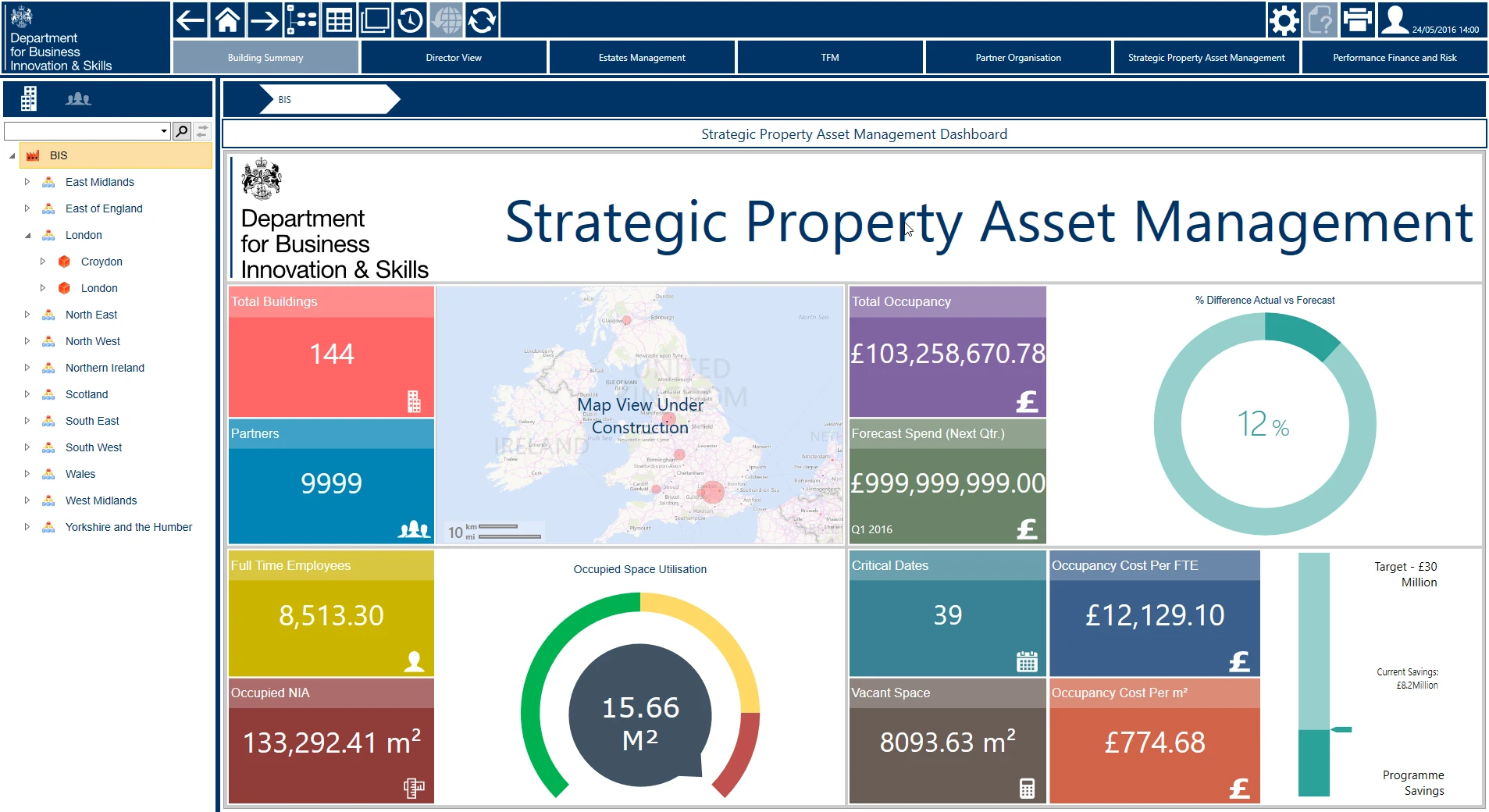
New system management dashboard screenshot
Results
The results have been staggering. BIS can now see and prioritize the most underutilized and energy inefficient buildings across the 180 buildings that they’re trying to rationalize. BIS estimated that the PAM team used to spend 75 percent of their data collating and validating data.
BIS foresees that this figure will drop to 15 to 20 percent. That’s 55 to 60 percent of their resources freed up! The rest of the time will be spent on actually adding value to the data; analyzing trends, making and testing hypotheses; truly taking data verified steps to improve underperforming properties.
The GENESIS visualization and future PowerBI integration is expected to save BIS at least one full-time employee per year. Most importantly, BIS have seen that our technology is powerful enough to interface with any other systems or data source when they’re ready, ultimately giving Central Government a futureproof platform.
Next Steps
BIS have an ambition to make the GENESIS system an industry standard across the whole Central Government, as well as to add real-time building automation data and push other data into PowerBI. We are already making steps to configure a ‘browser light version’ and a fully mobile responsive HTML5 version, built on GENESIS’ commercial off-the-shelf product MobileHMI™.