English
 Czech
Czech
 German
 French
 Italian
 Japanese
 Polish
 Spanish
 10 min read
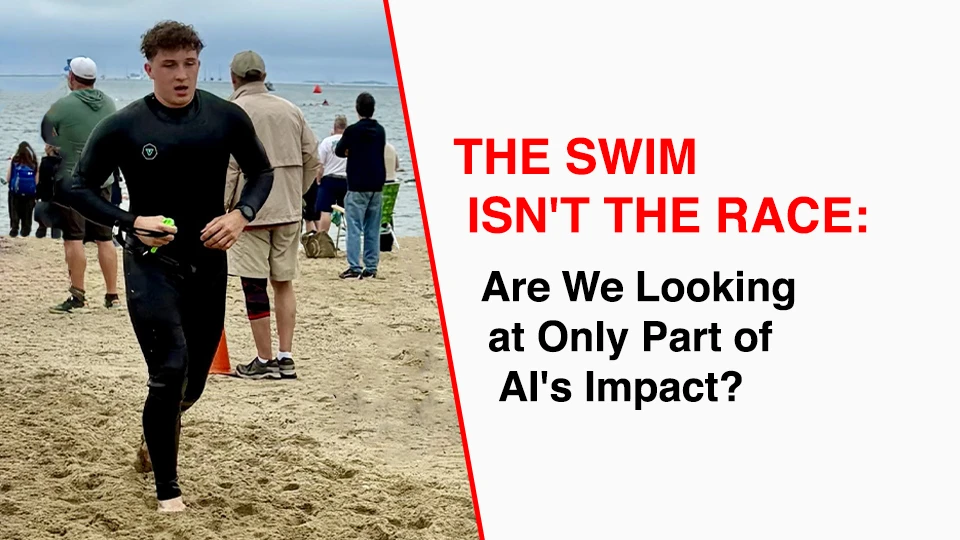
What a Triathlon Taught Me About AI in Software Development
This past summer, my 15-year-old son decided he wanted to compete in a triathlon. Being the supportive dad that I am, I agreed to train with him and even went so far as to say that I’d race with him.
Since it would be the first triathlon for both of us, we chose a sprint triathlon designed for beginners like us: a 750-meter swim, followed by a 20-kilometer bike ride and a 5K run. Looking at the course online, it didn't seem particularly intimidating. I'm reasonably active. I regularly run and bike sometimes, while my son is a sports freak who works out often. So, we figured we could do this!
The swim, however, was the sticking point for both of us because neither of us had much open-water swimming experience. And because the event was in Boston, we'd be swimming in the ocean...maybe with sharks in the water too. But how hard could half a mile in the water really be?
We had four weeks to train, so we went to a local lake to practice. About halfway through our first swim session, I hit a wall. I tried again two days later with the same result, and a third attempt didn't go much better.
We got wetsuits and gave it another shot. My son took to it immediately and got faster every time. I, on the other hand, was struggling to make it even halfway.
Eventually, I had to admit that I wasn't going to be ready in time. With more training, I probably could have completed the distance, but race day was approaching faster than my swimming ability was improving.
Meanwhile, my son just kept going. Maybe it's because he's 15. Maybe it's because I'm not. Whatever the reason, he seemed completely comfortable in the water while I was discovering muscles and breathing problems I didn't know I had. So, I made the difficult but strategic decision to become his coach.

In late August, he competed in the Boston Triathlon. Although his swim training had gone well, he knew it would be the hardest of the three legs. He came out of the water in last place in his under-19 age group. Standing on the shore watching him emerge from the swim, I assumed his race was pretty much over.
It wasn't.
The bike was next, and that's where his strengths started to show. He steadily worked his way through the field, moving up to 10th place before transitioning to the run. By the finish, he placed 13th out of 18 in his age group, with a final time of 1:28:32.
For his first sprint triathlon, with a goal of simply finishing and not drowning, I'd call that a success. He grinned from ear to ear wearing the finisher medal around his neck. I was one proud dad and coach.
Thinking about the race afterward, I realized how badly I had misunderstood where performance comes from. I thought the swim was the race. It wasn't.
The swim was simply the part I had been most focused on. It mattered, but it was only one leg of a much bigger race. My son came out of the water in last place and still finished strong because the outcome wasn't determined by a single stage.
Lately, I've been wondering if we're making the same assumption about AI.
AI Changing Industrial Software Development
For the first time in my career, I'm seeing AI fundamentally change how software and industrial solutions are conceived, designed, developed, tested, and deployed.
Consider what's already possible:
- With AI, requirements can emerge from conversations instead of weeks of documentation.
- With AI, engineers can evaluate more design alternatives before committing to a direction
- With AI, developers can generate working software in hours instead of weeks or months.
- With AI, teams can create test cases, documentation, and deployment artifacts alongside the solution instead of after the fact.
- With AI, teams can use mainstream tools such as Claude, Codex, and Copilot to configure systems designed for humans to configure.
AI isn't simply improving the product. It's changing the process used to create and configure the product, application, or platform.
The Economics of Software Development Are Changing
Historically, the biggest technology shifts haven't come from improving the end product. They've come from transforming how it's created. Consider a couple of examples:
- The assembly line didn't transform manufacturing because customers demanded assembly lines.
- Computer-aided design didn't change engineering because customers wanted CAD software.
Those technologies changed the economics of creation. I'm seeing AI do the same for both application development and the integration of commercial off-the-shelf systems like SCADA (Supervisory Control and Data Acquisition).
The companies that benefit most from AI may not be the ones that add the most AI features to their products. They may be the organizations that learn faster, experiment faster, develop faster, deploy faster, and improve faster. They may also be the organizations that use AI to increase the leverage of every engineer, product manager, designer, system integrator, and domain expert involved in building solutions.
From System Integration to Impact Engineering
The ability to use AI to accelerate how solutions are developed and deployed is particularly relevant in industrial automation and building information projects, where success often depends on rapidly configuring, deploying, and refining solutions across a wide range of customer environments.
A significant portion of project funding is dedicated to the engineering hours required to integrate systems. Sometimes, if budget remains, organizations can invest in training people to use those systems to make an impact.
System integrators who harness AI to accelerate engineering, visualization, testing, documentation, and deployment may find themselves delivering more value with the same teams, budgets, and schedules. They can move from project integration engineering toward more outcome-focused “impact engineering”.
That's a much bigger advantage than using a chatbot to troubleshoot a system after deployment or analyze operational data.
How Mitsubishi Electric Is Using AI to Accelerate Software Engineering
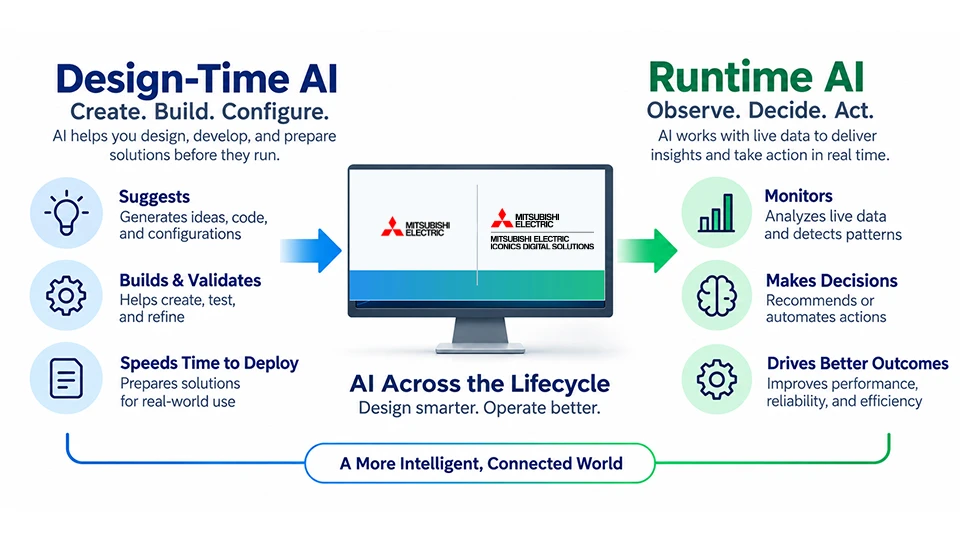
At Mitsubishi Electric, we're spending a significant amount of our attention on using AI to accelerate software and application development. Our teams are actively using generative AI to help build both our products and applications, including applications for HVAC equipment and GENESIS, our automation platform.
Much of our work is focused on accelerating how software and industrial applications are created in the first place. Some of the ways we're using and exploring AI include:
- AI-assisted software development: We're working daily with agent-based development workflows, automated harnesses, repository management, and AI-assisted engineering processes designed to help us release software faster and at higher quality. The goal isn't to replace developers, designers, or engineers but to increase the leverage of every engineer on the team.
- AI-assisted application project design: We're exploring how AI can accelerate application project design in GENESIS. Imagine describing an industrial application and having an online GENESIS service generate symbols, screens, visual assets, and navigation structures in minutes rather than hours. The team has run a beta of this tool for the last six months and has just released it to customers. It's an exciting tool that's getting better every week.
- AI-assisted GENESIS configuration: Even more interesting, we're experimenting with workflows where Claude can configure substantial portions of GENESIS, our automation software platform, over a weekend, producing project structures, configurations, and surprisingly polished visual experiences with minimal manual effort. In some cases, it isn't just a substantial portion. It's the entire project, followed by a QA agent that checks the work.
The Bigger Opportunity Before Deployment
These examples point to a bigger opportunity: using AI not only to accelerate engineering work, but also to free engineers to spend more time solving customer problems, improving operations, and creating measurable business impact.
Watching my son's triathlon taught me that the swim was only one part of the race. Coming out of the water in last place didn't determine his final result. He still had the bike and the run ahead of him, and that's where he was able to make up ground. I see a similar dynamic with AI. The real opportunity extends beyond what AI can do once a system is running. AI can also transform the way systems are engineered, configured, tested, and deployed.
As a result, AI can make the process of creating and deploying digital systems dramatically faster and less expensive.
What Happens When AI Frees Engineers to Focus on Impact?
That shift toward faster, less expensive development and deployment has an important consequence.
In GENESIS, every hour highly skilled engineers spend manually creating screens, writing repetitive configurations, generating documentation, or assembling deployment artifacts is an hour they aren't spending with customers, running kaizens, improving operations, or solving business problems. If generative AI can cut implementation effort significantly, organizations can redirect that investment toward activities that create measurable operational impact.
The project budget doesn't necessarily change. Where the effort is spent does. Less effort building the system. More effort improving the business with the system and solving meaningful problems. More resources available to improve the operations being controlled and monitored, rather than simply identifying problems without having the resources to address them.
Watching my son's triathlon reminded me that focusing on one leg of the race can make you miss where the outcome is really being shaped. The same may be true of AI. While much of the attention remains on what AI can do after deployment, some of its greatest impact may come from transforming everything it takes to get there.

I’d love to hear your thoughts. Connect with me on LinkedIn and let’s continue the conversation.
Key Takeaways
AI is changing more than what industrial software can do. It transforms how software and industrial solutions are conceived, designed, developed, tested, configured, and deployed.
- AI can accelerate the entire software development lifecycle. Requirements, design, development, testing, documentation, configuration, and deployment can increasingly be supported by AI.
- The economic impact of AI extends beyond adding AI features to products. Faster development and deployment can change the time, resources, and engineering effort required to create and implement industrial solutions.
- AI can increase the leverage of engineers and system integrators. Automating repetitive engineering, configuration, testing, and documentation can allow skilled teams to spend more time solving customer and operational problems.
- AI could help shift system integration toward “impact engineering. ”Reducing the effort required to build and integrate systems can free more project resources for improving operations and creating measurable business impact– within the same project budget.
- Mitsubishi Electric is already applying AI to software and application development. Current work includes AI-assisted software development, application project design, GENESIS configuration, GENESIS runtime data, IBSS interactions, and roadmaps with more.
- Some of AI’s greatest impact may happen before software deployment. Focusing only on what AI can do once a system is running ‘in runtime’ risks overlooking how profoundly AI can change everything required to get that system there.
Frequently Asked Questions
AI is beginning to change both industrial software and the engineering processes used to create and deploy industrial solutions. The following questions explore some of the key implications discussed in this article.
How is AI changing industrial software development?
AI can support multiple stages of software development, including requirements development, design evaluation, software generation, testing, documentation, configuration, and deployment. The opportunity extends beyond adding AI capabilities to finished products to changing the process used to create those products and applications.
How can AI help industrial engineers and system integrators?
AI can accelerate engineering-intensive activities such as visualization, configuration, testing, documentation, and deployment. Reducing time spent on repetitive implementation work can allow engineers and system integrators to devote more time to solving customer problems, improving operations, and creating business impact.
What does “impact engineering” mean?
In the article, “impact engineering” describes a shift from spending much of a project’s resources on system integration toward using more of those resources to improve operations and achieve business outcomes. AI-assisted engineering could help enable that shift by reducing the effort required to build and deploy systems.
How is Mitsubishi Electric using AI in software engineering?
Mitsubishi Electric is using and exploring generative AI across software and application development. Examples discussed in the article include agent-based development workflows, AI-assisted GENESIS application project design, and AI-assisted GENESIS configuration.
How could AI change the economics of industrial software development?
By reducing the time and engineering effort required to develop, configure, test, document, and deploy solutions, AI can potentially make digital systems faster and less expensive to create and implement. That can allow organizations to use the same project funding but slice that budget differently and redirect more resources toward operational improvement and customer outcomes.
Why might AI’s impact before deployment be especially important?
Much of the discussion around AI focuses on what AI can do within an operational system after deployment. The article argues that AI may have an equally significant impact on how those systems are engineered, configured, tested, and deployed in the first place.

Written By:
Recent Posts
What Is a Digital Workplace? Definition, Components, and Benefits
The High-Performance Office: Turning Data, AI and Smart Tech into Measurable Asset Value

Why Master Systems Integrators and Digital Enablement Decide Whether a “Smart” Building Is Actually Smart

Water Utility Cybersecurity: Building Operational Resilience Through Integrated SCADA and Controls

Smart Building Automation for Multi-Site Restaurants: How Centralized Operations Support Growth