English
 Czech
Czech
 German
 French
 Italian
 Japanese
 Polish
 Spanish
 9 min read
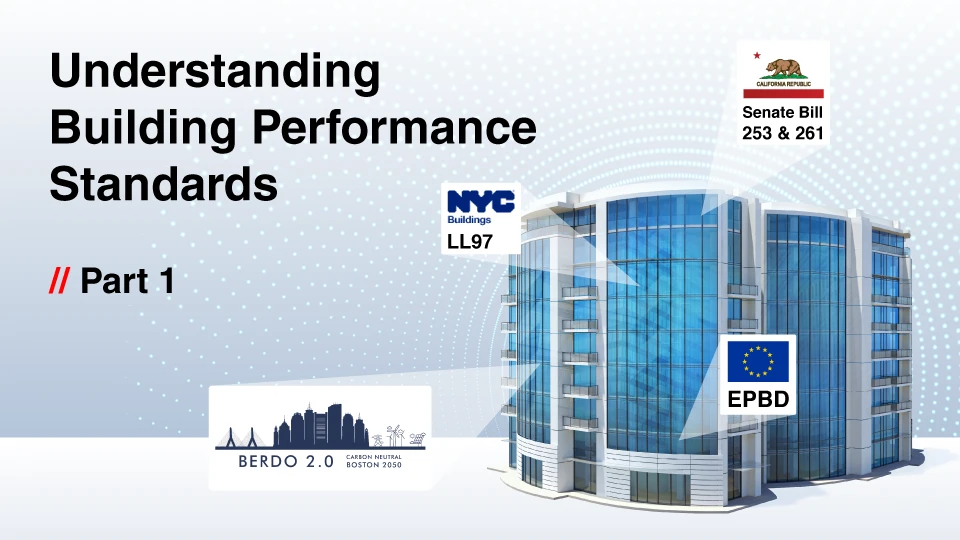
(This is part 1 of a 2-part series on navigating Building Performance Standards.)
In today’s real estate landscape, sustainability is no longer optional—and neither is compliance. As cities, states, and countries tighten the screws on carbon emissions and energy use, building owners face a new era of accountability. In some cases, it’s no longer enough to report data—building owners, landlords, and corporate occupiers are now expected to act on it with performance as the new standard.
Tech providers don’t often talk about policy, but when it comes to driving systemic change, it’s the blend of policy, technology, and market pressure pulling in the same direction that really moves the needle. This is a welcome shift, if it’s done right.
With the right tools and strategy, companies and property owners can take meaningful steps to protect the planet and support their communities—while maintaining an efficient, sustainable, and cost-effective operation.
To seize this opportunity and stay ahead of growing requirements, building owners and operators must first understand the changing regulatory landscape and what’s driving it.
Why Now: Rising Regulations and Market Pressures Are Reshaping Expectations
We’re living in a moment of accelerating climate action, where new regulations and expectations are converging. Across the globe, local and national governments are introducing new building performance mandates with real teeth—penalties, deadlines, and long-term implications.
What's more, these aren’t isolated developments; they signal a global convergence of regulatory pressure and market demand. Tenants, investors, and boards increasingly expect building performance to align with net zero targets. Simply put, buildings are now being measured by what they do, not just what they report.
Here are just a few examples making the headlines:
- New York City’s Local Law 97 imposes strict emissions caps on large buildings, with fines of $268 per metric ton of CO2e over the limit.
- California’s SB 253 and SB 261 require carbon disclosure and climate-related financial risk reporting.
- The EU’s Revised Energy Performance of Buildings Directive (EPBD) mandates renovation strategies and zero-emission targets across member states.
Meanwhile, market forces are adding pressure of their own, with tenants, investors, and boards demanding measurable sustainability outcomes. According to JLL, 13 U.S. cities have implemented Building Performance Standards (BPS) – and that number is expected to grow by 40 by 2026. Whether or not your city is on that list yet, it’s safe to say: it’s likely only a matter of time.
So yes – performance regulations are becoming the new normal. Unless, of course, you're in the United States, where regulatory momentum tends to come with a few speed bumps. (More on that in Part 2 of our building performance blog series.)
And disclosure rules don’t stop at the border. California’s regulations apply to more than 10,000 companies – including around 5,000 private firms not otherwise covered by SEC proposals (source: Pinsent Masons).
Even New York lawmakers are crafting similar legislation. Meanwhile, the EU’s Corporate Sustainability Reporting Directive (CSRD) reaches beyond to include any company €150M+ in EU revenues or securities listed on EU markets. Goldman Sachs estimates 67% of the S&P 500 will fall under CSRD rules.
Making Sense of the Terminology: Building Performance Standards
If you're confused by the buzzwords, you're not alone. It helps to clarify the key terms shaping the conversation around building disclosure:
- Building Performance Standards (BPS): Mandates that set actual energy or emissions thresholds buildings must meet over time. Unlike benchmarking or basic disclosure laws, BPS requires action.
- Example: New York City’s Local Law 97, which imposes strict emissions caps on buildings over 25,000 sq. ft. with fines of $268 per metric ton of CO2e over the limit.
- Benchmarking: The practice of measuring and disclosing energy use or emissions data for comparison, typically for public transparency and comparison. It improves transparency but doesn’t require performance improvement.
- Example: Boston’s BERDO 2.0 mandates buildings over 20,000 sq. ft. to report on energy, with fines for failing to report, but not (yet) for poor performance.
- MEPS (Minimum Energy Performance Standards): Legal efficiency baselines for building systems and appliances; these set the floor for how efficient equipment like HVAC, boilers, or lighting must be.
- Example: The EU’s Energy Performance of Buildings Directive (EPBD) sets Minimum Energy Performance Standards (MEPS) for brownfield upgrades, helping drive retrofit activity across member states.
In practice, some programs blur the lines, so the definitions above aren’t always clear-cut. For instance, Boston’s BERDO requires benchmarking; its recent updates introduce performance standards with enforcement mechanisms—putting it squarely into BPS territory. Beyond building-level mandates, there’s a broader shift in corporate regulation too.
Financial disclosure mandates like the U.S. SEC Climate Rule (proposed) and the EU’s CSRD are pushing firms to disclose climate risks and emissions in financial and ESG filings. While not building performance standards per se, they’re raising the bar—especially for real estate firms and their portfolios—by pressuring them to quantify and actively manage portfolio-wide carbon performance.
Understanding these distinctions helps clarify which programs are about data transparency and which are about decarbonization. Both matter, but they require subtly different tools and strategies.
Four Global Drivers Behind the Shift in Building Performance Standards
Building performance standards are gaining momentum now because the ground is shifting. From new laws to market demands, a cascade of global forces is transforming how buildings are valued, managed, and regulated—driving owners toward proactive performance. So why now? Four key trends explain the timing:
Climate Policy Is Becoming Operational Policy
National and local governments are translating carbon neutrality targets into building-level mandates. Buildings now account for roughly 40% of global emissions—and regulators are taking action.
Carbon Is a Cost Now
Operational emissions are not just an environmental concern—they're becoming a financial liability. Carbon penalties, energy price volatility, and disclosure rules are all hitting the bottom line.
Investor and Tenant Expectations
Market stakeholders expect transparency and action. “Brown discounts” (decreased asset value for underperforming buildings) are rising, while “green premiums” reward sustainability leadership. The growing adoption of Science-Based Targets (SBTs) shows how expectations are evolving. According to RMI, the number of firms for SBTs nearly doubled each year between 2020 and 2023.
And it’s not just pledges—real estate players are acting. In 2023, 73% of REITs set an emissions target, up from just 30% in 2018. Even more telling, 94% of REITs now report on portfolio-wide GHG emissions. This trend is fueled by investor pressure, ESG frameworks, and disclosure laws—both of which push firms to quantify and reduce emissions across scopes.
Technology Enables Accountability
Thanks to advances in smart building technology, there’s no excuse for flying blind. Cloud platforms, smart meters, and real-time integrated data make it easier than ever to see what’s happening and fix it.
Together, these drivers are rewriting the playbook for building operations—requiring owners and operators to rethink their approach, adopt smarter tools, and proactively manage performance.
Let’s look at what this means on the ground for those responsible for running today’s buildings.
What Performance-Based Regulation Means for Building Owners and Operators
What does this shift toward performance-based regulation mean for the people managing buildings day to day? For property managers, engineers, and sustainability leads, the new rules translate to:
- You need good data. Not once a year or inconsistent meter data, but accurate and continuous data to inform decisions and demonstrate compliance.
- You need connected systems. Not fragmented tools or isolated spreadsheets, but unified software that breaks down silos and brings all your data together.
- You need automation. Not manual workarounds or reactive reporting, but intelligent tools that flag issues, track emissions, and generate reports—automatically.
In short, this isn’t just compliance—it’s operational strategy. The more proactive you are, the greater the upside: smarter decisions, lower risk, and bigger savings.
Turn Compliance into a Competitive Advantage
Yes, building performance mandates can seem daunting. But they can also be a runway. Forward-thinking firms are using compliance as a launchpad for better performance, greater transparency, and strong brand value. Environmentally conscious companies don’t just meet expectations—they stand out. Investors take notice. Tenants pay attention. And occupants want to work there.
That’s where the right technology makes all the difference. With automation and digitalization software like GENESIS from Mitsubishi Electric Iconics Digital Solutions, you can transform compliance from a reactive task into a proactive strategy for performance, transparency, and digital growth.
With GENESIS, you can:
- Connect to and collect data from diverse sources, including meters, sensors, HVAC equipment, and third-party systems.
- Aggregate and standardize real-time data for energy use, equipment performance, and environmental quality across one or many sites.
- Automate reporting and emissions tracking, including support for platforms like Microsoft Cloud for Sustainability and Microsoft Sustainability Manager.
- Visualize performance across dashboards, floorplans, and Sankey diagrams to highlight inefficiencies and prioritize improvements.
- Enable cross-functional collaboration, allowing facility managers, sustainability teams, and executives to align on performance metrics.
- Predict and optimize performance using analytics that help teams prevent issues, reduce peak loads, and manage comfort levels effectively.
GENESIS doesn't just support compliance—it supports operational transformation.
Real-World Results: SUSTIE’s Path to a Net Zero Energy Building
Need proof?
A powerful example of what’s possible comes from the SUSTIE facility in Kamakura, Japan—Mitsubishi Electric Corporation’s smart building research center. Created to promote net-zero-energy design and demonstrate next-generation energy-saving technologies, the four-story facility integrates renewable power with automation to minimize environmental impact while maximizing comfort.
To support this ambitious vision, Mitsubishi Electric selected GENESIS as the core automation platform. With this building automation software, the SUSTIE team:
- Visualizes energy and emissions data with dynamic dashboards, including Sankey charts, floorplans, and time-series analysis.
- Collects and formats energy usage and emissions data for seamless integration with Microsoft Cloud for Sustainability and Microsoft Sustainability Manager.
- Calculates Scope 2 CO₂ emissions using automated workflows, reducing manual data handling and accelerating decision-making.
- Manages room occupancy, power consumption, and HVAC operation in real time.
- Improves occupant experience with tools from Mitsubishi Electric Iconics Digital Solutions’ Intelligent Buildings Software Stack (IBSS), such as desk booking, room control, and digital signage for navigation.
What used to take weeks of manual effort is now streamlined into an automated, integrated system that supports Mitsubishi Electric’s environmental goals and provides a living demonstration of what smart, sustainable building management can achieve.
SUSTIE’s results speak for themselves:
- Significant (52%) reduction in CO₂ emissions
- Seamless integration across systems
- Real-time energy optimization with transparent reporting
- Occupant-centered design without compromising efficiency
Read the full success story to explore how SUSTIE achieved these results and how you can apply the same strategies.
In a broader context, as building performance standards become the norm, the SUSTIE case shows how digital transformation for buildings is not only feasible—it’s powerful, measurable, and future-ready.
SUSTIE offers a glimpse into what’s achievable—and scalable—when digital tools are aligned with bold sustainability goals. Now it’s your turn.
Takeaways: Turn Mandates into Momentum
This regulatory wave isn’t going away. So, with the right tools and mindset, you can surf it, rather than get swamped by it.
Here’s how to get started:
- Audit your current systems: Know what data you’re collecting, where gaps exist, and how your performance stacks up against upcoming mandates.
- Invest in integration: Unified platforms like GENESIS help consolidate base build data, automate reporting, and reduce administrative overhead.
- Prioritize real-time insight: The faster you can spot inefficiencies or compliance issues, the faster you can act—and save. Whether it’s half hourly meter data, or integrations to BMS and the grid—think speed.
- Engage your full team: From facility managers to sustainability analysts, everyone has a role to play in driving performance and unlocking value. Obtaining buy-in across different functions and roles can go a long way toward ensuring a successful transformation.
These steps can help you turn compliance into a catalyst for smarter operations—and lasting impact.
What's next?
In Part 2, we’ll dive deeper into the legislation mentioned above, demystifying the specifics, timelines, and compliance implications of major standards and what they mean for different types of building portfolios.
Ready to Turn Building Mandates into Business Wins?
Explore how GENESIS software helps you:
- Lead with intelligence
- Meet building performance mandates
- Transform operational challenges into strategic opportunities.
As a bonus, we’ve put together a glossary of key policies, standards, and regulations that are reshaping the smart building landscape, along with what they mean for your business.
Glossary of Key Building Performance Standards and Regulations
| Term / Standard | Type | What It Does |
| Benchmarking and Disclosure | Disclosure Law | Public disclosure of energy/emissions use; transparency without mandatory action |
| Building Performance Standards (BPS) | Policy | Requires measurable performance improvements or emissions reductions |
| Minimum Energy Performance Standards (MEPS) | Regulation | Sets legal efficiency floors for systems like HVAC, lighting, boilers |
| NYC Local Law 97 | BPS, Policy | Imposes emissions caps on NYC buildings over 25,000 sq. ft.; fines $268/ton CO₂e fines |
| Boston BERDO 2.0 | Benchmarking → BPS, Disclosure Law, Policy | Requires reporting on buildings >20,000 sq. ft.; evolving toward performance-based enforcement |
| EU EPBD | MEPS → BPS | Sets minimum performance for systems; mandates zero-emission targets for member states |
| California SB 253/261 | Disclosure Law | Requires GHG emissions and climate risk reporting for 10,000+ firms |
| EU CSRD | Disclosure Law | Requires ESG/climate reporting from any firm with securities or €150M+ revenue in EU |
| SEC Climate Rule | Disclosure Law | (Proposed), but will require large U.S. public firms to disclose GHGs and climate-related risks |

Written By:
Recent Posts
Smart Building Automation for Multi-Site Restaurants: How Centralized Operations Support Growth

Scaling Data Center Infrastructure Requires a New Approach to Monitoring

Why Retro-Commissioning Should Come Before Energy Efficiency Investments in Commercial Buildings

Why Connected Buildings Begin with Digital Signage

Modern Mining Requires More Than Traditional SCADA