 English
 Czech
Czech
 German
 French
 Italian
 Japanese
 Polish
 Spanish
Category: Sustainability , Utilities and Energy
The SUSTIE ZEB Building by Mitsubishi Electric Corporation

Kamakura, Japan

Category: Sustainability , Utilities and Energy
Kamakura, Japan

“At SUSTIE, we are researching and demonstrating future smart buildings to achieve both comfort and energy efficiency in buildings. For example, with the flexible dashboard features of GENESIS64, we were able to create dashboard screens that effectively represent performance metrics of SUSTIE. We also organize tours to showcase our work to our customers. It is important to clearly introduce our R&D results to visitors such as customers, real estate developers, design firms, and so on.”
Mitsubishi Electric Corporation supports the United Nations Sustainable Development Goals and has defined specific corporate objectives as part of their Environmental Sustainability Vision. In line with these initiatives, Mitsubishi Electric Corporation created the SUSTIE facility to research, develop, and demonstrate Net Zero Energy Building (ZEB) technologies to promote energy savings, occupant wellness and comfort, and social acceptance of carbon neutrality. Pronounced /sah-stee-e/, “SUSTIE” combines the words “sustainability” and “energy” to denote the building’s net-zero-energy design and function. The four-story building is located in Mitsubishi Electric’s eastern Research & Development campus in Kamakura, Japan.
A Net Zero Energy Building (ZEB) creates zero, or almost zero, net primary energy consumption annually through energy-saving technologies or a combination of energy-saving technologies and renewable energy sources. In Japan, this is achieved by minimizing energy consumption through efficient design and operation, while also utilizing on-site renewable energy sources, such as solar or wind power, to offset any energies produced. In essence, the building balances its energy demand and supply. A key to ZEB is to deliver energy savings while maintaining a comfortable and healthy indoor environment for occupants.
“At SUSTIE, we are researching and demonstrating future smart buildings to achieve both comfort and energy efficiency in buildings. For example, with the flexible dashboard features of GENESIS64, we were able to create dashboard screens that effectively represent performance metrics of SUSTIE. We also organize tours to showcase our work to our customers. It is important to clearly introduce our R&D results to visitors such as customers, real estate developers, design firms, and so on.”
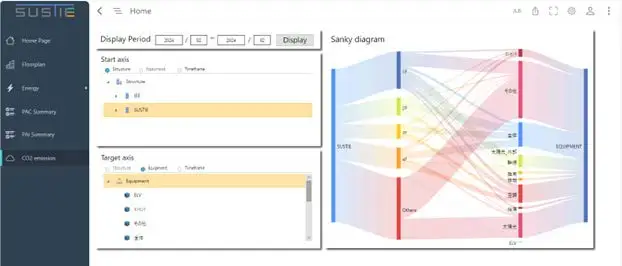 Sankey visualization chart showing energy and CO2 consumption by floors and equipment, highlighting key contributors for targeted optimization
Mitsubishi Electric needed automation software to optimize the building’s operations, manage energy usage, and monitor CO2 emissions. As a group company and long-time collaborator of Mitsubishi Electric, our automation software was the logical choice for SUSTIE. In 2021, SUSTIE started using GENESIS64 to manage the occupancy and environment of each room, manage power consumption, and monitor the operation status of air conditioning equipment.
In 2022, Mitsubishi Electric Iconics Digital Solutions participated in the Microsoft Cloud for Sustainability (MCfS) Insider Program and served as a launch partner for MCfS general availability. SUSTIE worked with us to automate the process of collecting and uploading building power consumption data to MCfS to calculate and visualize CO2 emissions. We released public MCfS support in May 2023 as part of the 10.97.2 CRF2 release of GENESIS64. Then in 2024, the SUSTIE team adopted Microsoft Sustainability Manager, a software-as-a-service (SaaS) offering within Microsoft Cloud for Sustainability, which serves as the foundation of its sustainability management tools.
A floorplan visualization of environmental conditions for optimized comfort: CO2, CO, TVOC, temperature, pollen, humidity, and formaldehyde
Sankey visualization chart showing energy and CO2 consumption by floors and equipment, highlighting key contributors for targeted optimization
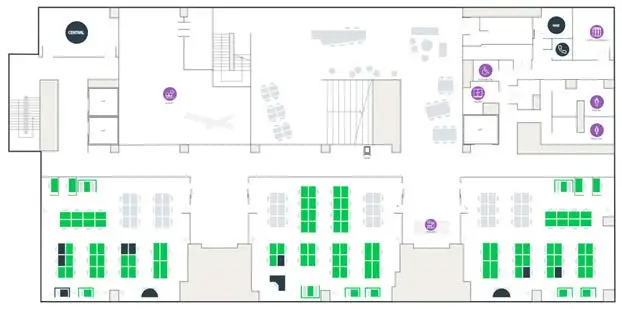 Real-time interactive map from IBSS showing seat availability, busy areas, and amenities for efficient navigation and workspace use
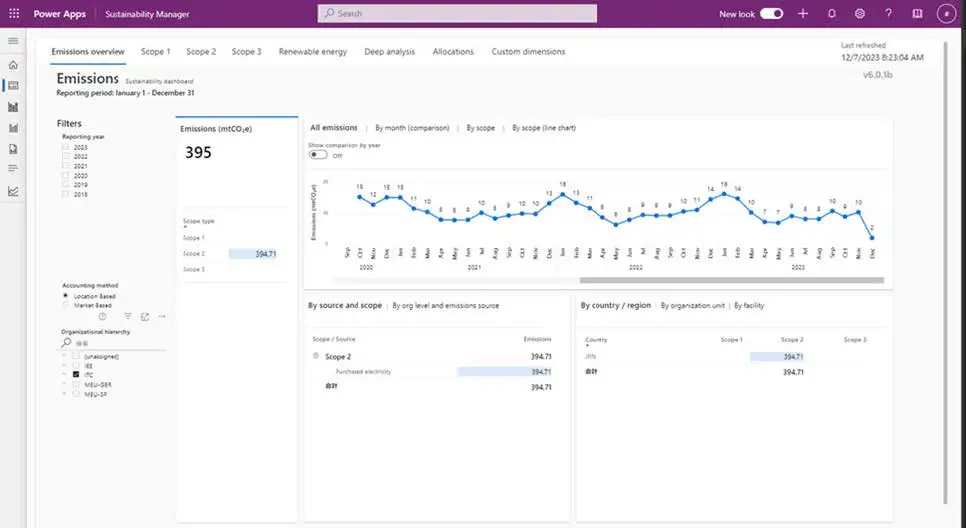
Microsoft Sustainability Manager: monthly emissions overview
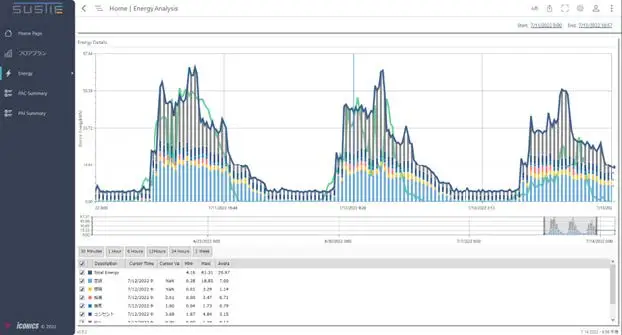
Time-series energy consumption analysis: daily kWh totals split by energy source
Real-time interactive map from IBSS showing seat availability, busy areas, and amenities for efficient navigation and workspace use
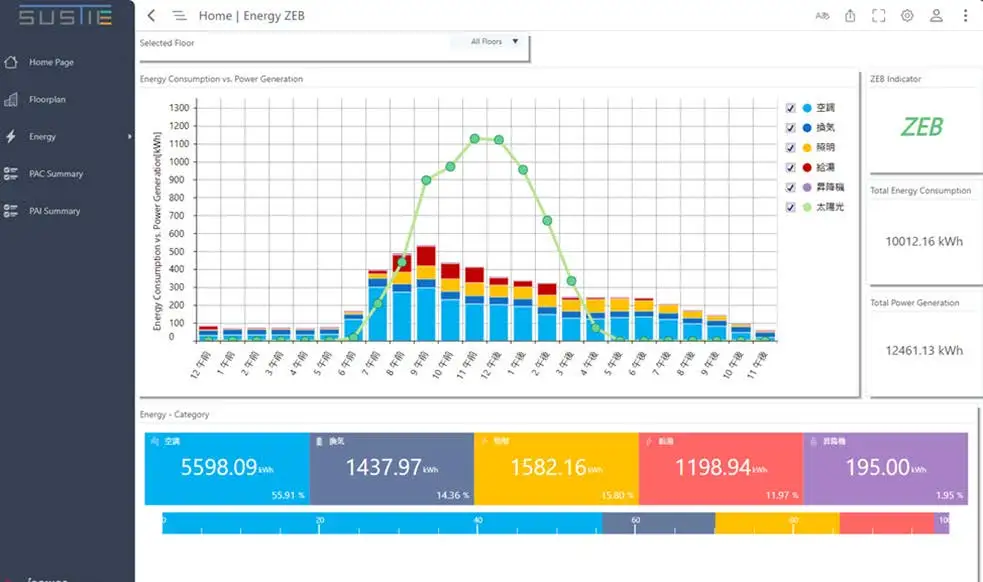 Real-time energy balancing: energy consumption vs power generation
SUSTIE realized substantial benefits with Mitsubishi Electric Iconics Digital Solutions automation software. The initial integration between GENESIS64 and MCfS was completed within a short period of three weeks, resulting in minimal engineering work during the implementation phase. Previously, Mitsubishi Electric was unable to measure and manage CO2 emissions in the SUSTIE building. Now with GENESIS64, the SUSTIE team can automatically aggregate and format sensor, equipment, and output power consumption data in the Microsoft Sustainability Manager format, calculate Scope 2 CO2 emissions, and represent this data using the Microsoft Sustainability Manager reporting tool.
Real-time energy balancing: energy consumption vs power generation
Imagine a world where buildings are self-sufficient in energy generation and leave no carbon footprint behind. At the SUSTIE facility, that future is becoming a reality. Mitsubishi Electric’s revolutionary research center is showing the world what sustainable architecture and operations can achieve.
Moreover, the SUSTIE facility is a testament to Mitsubishi Electric Corporation’s support for the UN’s Sustainable Development Goals and to their efforts to promote worldwide sustainability and carbon neutral initiatives. Powered by Microsoft Azure, the GENESIS64 integration with the Microsoft Sustainability Manager provides carbon emission management and visualization. This capability extends GENESIS64's predictive analytics of energy consumption, building performance, and occupant comfort to provide secure control of building automation systems. The SUSTIE implementation currently calculates Scope 2 and Scope 3 – Category 5 CO2 emissions, and they are exploring additional Scope 1 and Scope 3 CO2 emission management.
“SUSTIE’s building management system lacked the capability to manage CO2 emissions. We therefore planned to develop a platform for CO2 emissions management to evaluate the cutting-edge technologies on the platform as soon as possible. With the support from Mitsubishi Electric Iconics Digital Solutions (previously ICONICS), we were able to achieve CO2 emission management within a short period of time.”
“SUSTIE’s building management system lacked the capability to manage CO2 emissions. We therefore planned to develop a platform for CO2 emissions management to evaluate the cutting-edge technologies on the platform as soon as possible. With the support from Mitsubishi Electric Iconics Digital Solutions (previously ICONICS), we were able to achieve CO2 emission management within a short period of time.”