English
 Czech
Czech
 German
 French
 Italian
 Japanese
 Polish
 Spanish
 4 min read
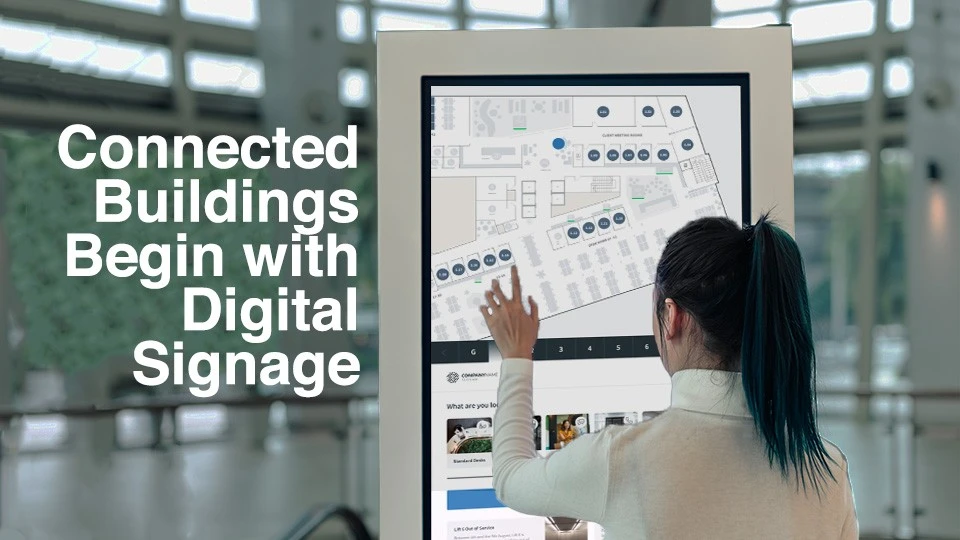
Walk into almost any modern office building, hospital, university, hotel, or fitness center, and a clear pattern emerges: people increasingly expect buildings to communicate.
Visitors expect buildings to answer everyday questions. Where’s my meeting? Which way is the lift? Is there anywhere free to sit? What's on today? Digital communication has become part of the everyday building experience.
Commercial real estate is responding by creating more connected tenant experiences. As location and amenities become less distinctive, building experience has become a key competitive advantage.
JLL identifies technology-enabled tenant experiences as an increasingly important differentiator, helping landlords attract and retain tenants by creating more engaging workplaces and improving how occupants interact with buildings and workplace services.
From a Wall of Screens to Occupant Value
Digital signage used to mean a few local restaurant adverts and maybe a room schedule. That era is over. Signage in a well-run building now greets visitors, provides directions, shares information, signals Environmental, Social, and Governance (ESG) credentials, and makes the building feel looked after.
When a screen is wired into the building itself, it stops showing content and starts showing truth: the restaurant that's quietest right now, the air quality on this floor this minute, the meeting space that's filling up, the route to the desk you just booked.
The best way to describe this: the building explains itself.
The Real Purpose of Digital Signage
Every day, occupants make dozens of small decisions. Where should I park? Which meeting room is available? How do I find my destination? Where are nearby amenities? What is happening in the building today?
Modern buildings increasingly answer those questions through connected digital experiences rather than printed signs, reception desks, or another mobile application. Occupants receive the right information at the right place and at the right time.
Delivering accurate, real-time information synchronised with occupancy, bookings, environmental conditions, and building systems requires more than a media player. A connected building data layer provides the operational foundation for the building operating system, connecting applications, sensors, and building systems, so every display reflects real-time building conditions.
Digital signage becomes the visible interface between connected building data and building occupants, delivering the right information where and when it is needed.
As the building's digital interface, digital signage helps organisations:
- Create welcoming first impressions with personalized visitor and tenant communications.
- Simplify arrival experiences with parking availability, visitor check-in, and real-time building information.
- Help occupants navigate buildings confidently through interactive wayfinding and digital maps.
- Improve workplace efficiency by displaying live meeting room and workspace availability.
- Keep occupants informed with workplace announcements, events, and building communications.
- Improve safety and responsiveness through real-time emergency notifications and critical building updates.
- Demonstrate building performance through live indoor air quality, occupancy, sustainability, and other operational information.
Unlike a mobile application, digital signage delivers information where occupants need it, reducing routine enquiries to building staff.
Building Experience Has Become a Competitive Advantage
For landlords and developers, connected digital experiences help differentiate properties in competitive leasing markets, strengthen tenant engagement, support leasing, and improve tenant retention.
For corporate occupiers, the same capabilities reduce workplace friction, improve workplace efficiency, simplify navigation, reduce time spent searching for spaces, and create a more connected employee experience.
These outcomes demonstrate how digital signage has evolved from a communication tool into a strategic component of the connected building.
Signage Is Where You Start, Not Where It Stops
Because every screen draws from the same live data layer, digital signage is only one application of a connected building platform. The same building operating system that delivers accurate information to every display also powers visitor management, room and desk booking, and the accredited performance ratings that increasingly shape a building's value.
That changes what software you're actually deploying. Start with signage because it's the most visible, lowest-friction way in, but understand that you're not buying a set of screens. You're switching on the first surface of a connected building.
Every new connected capability draws on the same operational data. The visitor journey that begins at reception draws on the same data displayed on the lobby screen. The live air quality displayed on that screen draws from the same data layer that supports NABERS ratings and demand-driven control strategies.
Each new capability becomes a configuration change on a platform you already have, not another system to buy, integrate, and hope talks to the rest.
The question stops being "Which digital signage solution should I choose?" and becomes "What outcomes do I want my building to deliver?" Once those outcomes are defined, the next step is choosing a solution that provides the connected software foundation to deliver them today while supporting future building requirements.
The Connected Foundation Behind Every Digital Experience
Connected building experiences require software that integrates tenant experience applications, smart building systems, and edge-to-cloud data within a unified digital foundation. Mitsubishi Electric Iconics Digital Solutions delivers that connected architecture.
Ready to Build a More Connected Building?
See how connected tenant-experience and building-performance applications turn digital signage into the first step of a smarter building.
Contact our intelligent buildings experts to discuss your building strategy.

Written By:
Recent Posts
What Is a Digital Workplace? Definition, Components, and Benefits
The High-Performance Office: Turning Data, AI and Smart Tech into Measurable Asset Value
Why Master Systems Integrators and Digital Enablement Decide Whether a “Smart” Building Is Actually Smart

The Swim Isn't the Race: Are We Looking at Only Part of AI's Impact?

Water Utility Cybersecurity: Building Operational Resilience Through Integrated SCADA and Controls