English
 Czech
Czech
 German
 French
 Italian
 Japanese
 Polish
 Spanish
 6 min read
(This is Part 2 of a two-part series on navigating Building Performance Standards. Read Part 1 here.)
What You’ll Learn in This Blog
By the end of this post, you’ll understand how to:
- Define building performance standards (BPS) and distinguish these from disclosure or benchmarking rules
- Identify the global regulations shaping compliance in the U.S., Europe, and the U.K.
- Recognize the core requirements most BPS frameworks share—baseline assessments, targets, reporting, penalties, and compliance paths
- Prepare property managers, engineers, and sustainability leads to manage portfolios for compliance
- Leverage compliance as more than a mandate by creating operational and competitive advantages
From Policy to Practice: Why Execution Is the Real Challenge
In Part 1, we laid the groundwork—why building performance matters and what’s driving change. Now it’s time to unpack the details: the regulations taking shape around the world, what these actually require, and how you can turn compliance into a business advantage.
For many organizations, the message that “compliance is coming” misses the point. The real challenge isn’t awareness—it’s execution. Managing large portfolios across multiple jurisdictions means wrangling data from scattered sources (typically spreadsheets), applying consistent standards, and converting the results into decisions that materially move the needle.
Verdantix points out that fragmented teams and siloed data make scaling compliance across portfolios far more difficult than simply “hitting a power button.” Even more sobering, their research shows many large organizations face multi-million-dollar gaps between existing budgets and what’s needed for deep decarbonization. For example, healthcare institutions face an average $22.7M funding shortfall per organization.
Bottom line? These rules aren’t abstract policy targets but operational realities that can reshape strategy, budgets, and day-to-day building management. Without unified data, portfolio segmentation, and automated monitoring, even the best intentions can quickly falter.
Quick Refresher: What Are Building Performance Standards?
Building Performance Standards (BPS) are mandates that set measurable thresholds for building energy use or emissions, requiring owners and operators to take action—not just report data. These standards differ from benchmarking or disclosure laws by introducing enforceable performance requirements and penalties for non-compliance.
Snapshot: Global Building Performance Standards at a Glance
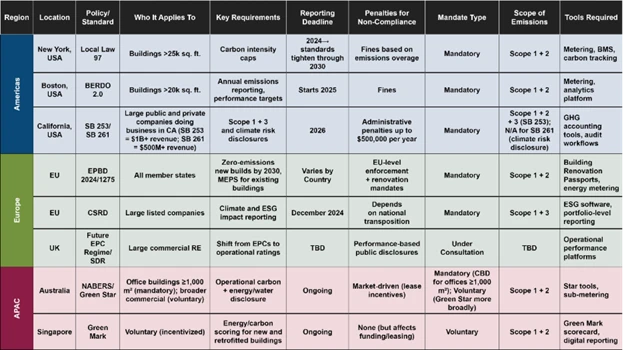
Here’s a quick look at some of the most prominent building performance regulations shaping compliance worldwide:
- United States: New York’s Local Law 97 sets strict emissions caps; California’s SB 253/261 add carbon disclosure and financial risk reporting.
- Europe: The EU’s Energy Performance of Buildings Directive (EPBD) pushes for zero-emission buildings, while CSRD requires thousands of firms (including non-EU companies) to disclose sustainability data.
- United Kingdom: NABERS UK and MEES are creating performance-driven baselines for both new and existing buildings.
The table below provides a summary of key details.
(Sources: Building Performance Standards – Building Energy Codes Program; BECP Status of State Energy Code Adoption – Tableau Public)
Different in scope but aligned in purpose, these standards are converging on common requirements—annual reporting, escalating penalties, and performance-based targets tied to carbon intensity or energy use. Building performance is no longer just about transparency—it’s about measurable outcomes. Which raises the critical point: while the rules vary by region, they share a common set of expectations.
What Do These Building Standards Typically Require?
Despite regional differences, most BPS frameworks share a common structure:
- Baseline assessments – Typically using tools like Energy Star Portfolio Manager or national equivalents to establish current performance.
- Performance targets – Based on energy use intensity (EUI), emissions per square foot, or carbon intensity metrics.
- Regular reporting – Annual or triennial filings, with penalties for missed deadlines or insufficient improvement.
- Penalties or escalation mechanisms – Fines, public disclosure, or stricter enforcement if targets aren’t met.
- Paths to compliance – Often a combination of retrofits, operational improvements, and smart building technologies.
As Verdantix notes, lighter retrofits and operational strategies are frequently the most scalable decarbonization paths—especially for large portfolios where deep retrofits may be cost-prohibitive.
How Can Property Managers, Engineers, and Sustainability Leads Prepare for Compliance?
For property managers, engineers, and sustainability leads, these regulations translate to practical challenges and opportunities. Here are the next moves to focus on:
- Map your obligations – Identify which standards apply across your portfolio, by geography and building type.
- Centralize your data – Bring together meter, utility, emissions, and equipment data into a single platform.
- Segment your portfolio – Focus first on the worst performers and sites with the highest compliance exposure.
- Automate reporting – Replace manual, error-prone processes with dashboards and automated workflows.
- Balance compliance with ROI – Use technology that doesn’t just check boxes but also improves efficiency and cuts costs.
- Track and iterate – Build compliance into daily operations, so progress is measured continuously—not just at reporting deadlines.
Smart building platforms like GENESIS from Mitsubishi Electric Iconics Digital Solutions make this possible. By unifying diverse data sources, automating reporting, and providing advanced visualization and analytics, GENESIS helps organizations move from reactive compliance to proactive operational improvement.
Take a REIT (Real Estate Investment Trust) with assets across Boston, London, and Paris: such an organization is navigating three completely different regulatory frameworks, reporting systems, and even languages.
For portfolio owners, the challenge isn’t just compliance — it’s coordination. Without a global “system of systems” to unify data, normalize performance metrics, and automate reporting, compliance becomes a high-risk juggling act.
The Benefits of Building Performance Standards Compliance
As you can see, performance standards can feel daunting, but these can also be a catalyst for smarter operations. By approaching compliance as an opportunity—rather than just a mandate—you can:
- Reduce the risk of fines and reputational damage
- Improve operational efficiency and resilience
- Strengthen tenant, investor, and community trust
- Create long-term asset value through sustainability leadership
This regulatory wave isn’t going away. With the right tools and strategy, you can surf it—rather than get swamped by it.
Still have questions? Here are answers to some of the most common concerns building owners, engineers, and sustainability leaders raise about BPS compliance.
FAQs on Building Performance Standards
What is the difference between benchmarking and building performance standards?
Benchmarking requires owners to track and report energy or emissions data, while BPS set enforceable performance thresholds and carry penalties for non-compliance.
Which regions have the most advanced building performance standards today?
The U.S. (e.g., New York’s Local Law 97, California’s SB 253/261), the European Union (EPBD and CSRD), and the U.K. (NABERS UK and MEES) are among the leaders shaping global compliance requirements.
What do building performance standards usually require from building owners?
Most frameworks require a baseline assessment, performance targets tied to energy use or emissions, regular reporting, and penalties for non-compliance. Compliance paths often include retrofits, operational improvements, and adoption of smart building technologies.
Who is responsible for BPS compliance within an organization?
Typically, responsibility spans property managers, engineers, and sustainability leads, but finance and executive leadership also play a role given the budgetary and strategic impacts.
How can technology help with compliance?
Smart building platforms like GENESIS unify scattered data, automate reporting, and provide advanced visualization and analytics—helping organizations reduce manual effort, improve efficiency, and move from reactive compliance to proactive performance management.
Ready to Turn Building Mandates into Business Wins?
Explore how GENESIS software helps you:
- Unify fragmented data and manage performance with intelligence
- Simplify reporting to meet building performance mandates
- Turn compliance challenges into operational and competitive advantage
Contact us to learn more about how GENESIS can support your building performance strategy.

Written By:
Recent Posts

What Is a Data Historian in OT? Definition, Architecture, and Applications

What Is a Digital Workplace? Definition, Components, and Benefits

The High-Performance Office: Turning Data, AI and Smart Tech into Measurable Asset Value

Why Master Systems Integrators and Digital Enablement Decide Whether a “Smart” Building Is Actually Smart