English
 Czech
Czech
 German
 French
 Italian
 Japanese
 Polish
 Spanish
 10 min read
What You’ll Learn in This Blog
By the end of this post, you’ll learn how to:
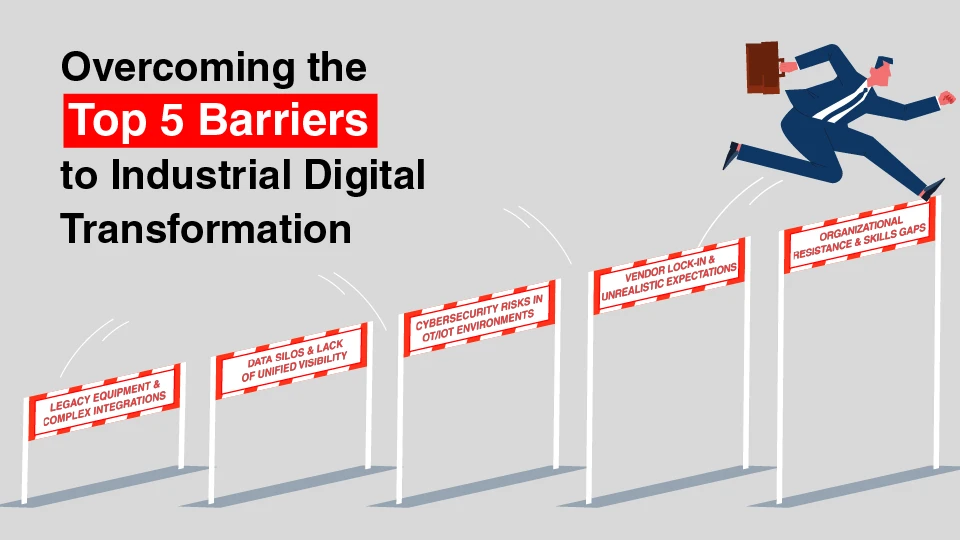
- Identify the five most common barriers to industrial digital transformation
- Understand why legacy equipment, data silos, cybersecurity risks, vendor practices, and organizational resistance stall progress
- Apply practical, field-tested approaches that overcome these challenges
- See how a modern SCADA platform like GENESIS enables scalable, secure, and future-ready digital transformation
- Recognize the organizational practices — like change management and clear KPIs — that make transformation sustainable
Lessons from the Field
With more than 25 years in industrial SCADA automation and digital solutions, I’ve seen and learned a few things about industrial technology projects. Chief among those lessons is this: technology projects rarely fail because of one big mistake. Most failures come from dozens of smaller, reoccurring obstacles that slowly stack up over time.
When I first started helping companies modernize their operations—now commonly called digital transformation—I quickly realized something that isn’t often said out loud: upgrading to a new SCADA or digital transformation platform is rarely plug-and-play.
Plants often carry decades of equipment installed by multiple vendors. Many of those systems were never designed to communicate with each other, let alone integrate into today’s secure, connected world.
The insights in this blog come straight from the field and from my work with customers—the barriers that repeatedly stall industrial digital transformation and the practical approaches that actually move projects forward.
Industrial Digital Transformation Challenges: 5 Barriers and Practical Solutions
Barrier 1: Legacy Equipment and Complex Integrations
Industrial plants often operate with legacy SCADA hardware such as PLCs that were not designed for modern, secure communication protocols. Connecting those older devices to today’s platforms can feel like forcing square pegs into round holes. Middleware, adapters, and even full hardware replacements are frequently required, adding cost and creating operational risks.
What Works in Practice
Success starts with platforms that support open standards and a wide range of industrial protocols—OPC UA, MQTT, BACnet, SNMP, and more. This extensibility reduces the need for costly hardware swaps and minimizes downtime. A phased approach to integration, paired with simulation and testing, ensures new systems can coexist with old ones while delivering value early in the project.
Barrier 2: Data Silos and Lack of Unified Visibility
Data in industrial environments typically lives in multiple isolated systems—ERP, MES, historians, and SCADA systems. Each repository serves a purpose, but the lack of integration prevents stakeholders from seeing a complete picture of operations. As organizations attempt to scale solutions across sites, the problem intensifies: what worked at one plant collapses under the complexity of multi-site deployments.
What Works in Practice
Breaking down silos requires a centralized data platform that aggregates and validates information from all systems. Modern building and industrial management platforms can normalize disparate data, provide web-based visibility, and enable advanced analytics. By centralizing data into a trusted backbone, leaders gain clarity, scalability, and actionable insights that were previously hidden.
Barrier 3: Cybersecurity Risks in OT/IoT Environments
Industrial networks were originally built to be isolated and proprietary. As organizations connect OT systems with IT networks and the cloud, vulnerabilities multiply. Cyberattacks now target industrial control systems directly, and breaches can result in downtime, safety incidents, or environmental harm.
What Works in Practice
A secure foundation is essential. Role-based access control, encryption, network segmentation, and audit trails should be non-negotiable features of any platform. Security also depends on governance: clear policies, regular training, and coordination between IT and OT teams. Organizations that view cybersecurity as an ongoing discipline—not a one-time investment—are far better positioned to mitigate risks. Just as important, companies should deploy advanced SCADA systems with built-in security protocols and certifications from recognized standards bodies, such as ISO/IEC 27001:2022 and IEC 62443, to ensure resilience against evolving threats.
Barrier 4: Vendor Lock-In and Unrealistic Expectations
Some platforms lock customers into proprietary technologies, making future flexibility expensive or impossible. In addition, promotional materials often oversell advanced features such as predictive maintenance or AI, suggesting instant results when in reality those capabilities demand high-quality data and careful configuration. The mismatch between expectations and reality creates frustration, wasted resources, and disillusioned teams.
What Works in Practice
Open, standards-based platforms avoid vendor lock-in and allow organizations to adapt their digital ecosystems over time. Clear scoping is also essential: advanced analytics should be introduced gradually, once the foundation of data quality and visibility is in place. A practical roadmap—with milestones that can be measured—helps manage expectations and builds credibility with stakeholders.
Barrier 5: Organizational Resistance and Skills Gaps
Even the best technology can stall without organizational alignment. Operators and engineers often resist new systems, preferring familiar tools and processes. IT and OT teams sometimes clash over ownership, creating confusion and delays. Skills gaps in areas such as cybersecurity, industrial networking, or data analytics exacerbate the problem. Many projects also suffer from poorly defined objectives and lack of clear KPIs, making it difficult to prove value and sustain funding.
What Works in Practice
Strong change management practices make the difference. Successful organizations invest in training, communication, and role clarity to build trust across teams. IT and OT leaders should be aligned from the outset, with clear ownership of systems and outcomes. Most importantly, projects must be tied to well-defined KPIs that track operational efficiency, energy use, safety, or compliance. Demonstrating measurable results early fosters stakeholder buy-in and builds momentum.
Moving from Barriers to Breakthroughs
These barriers are daunting but are not insurmountable. In my experience, the organizations that succeed approach digital transformation with two essentials: a clear strategy for people and processes and a technology foundation designed to support that strategy. Best practices can take projects a long way, but without the right platform, progress is difficult to sustain.
That's why I want to share not only how strategies work in practice, but also how a technology foundation built for industrial environments can accelerate success. Industrial organizations don't just need another software tool; they need the right combination of automation technologies, software, and expertise designed for scale, security, and adaptability.
Mitsubishi Electric automation technologies combined with GENESIS HMI/SCADA software from Mitsubishi Electric Iconics Digital Solutions provide a powerful foundation for industrial digital transformation.
Built with a modular architecture, extensibility through modern APIs, and mission-critical readiness, the platform unifies legacy equipment, modern IoT devices, and enterprise systems into one secure, centralized backbone. GENESIS is engineered for the realities of industrial digital transformation, addressing the barriers that often stall progress and providing organizations with a foundation for lasting success, supported by key capabilities such as:
- Flexible and Scalable Deployment – Single machine to multi-node global deployments with unlimited client connections.
- Universal Connectivity Across IT, OT, and IoT – Broad protocol support connects old and new equipment, seamlessly converging IT with OT into one unified platform.
- Integrated Industrial Historian – High-resolution data capture that simplifies reporting, compliance, and analytics.
- Best-in-Class Visualization – Intuitive dashboards and HMI tools for operators and managers.
- Robust Extensibility with Modern APIs – Open integration and customization without vendor lock-in.
- Secure by Design, Mission-Critical Ready – Built-in redundancy, failover, and encryption ensure operations stay protected and online.
- Contemporary Lifecycle Management – Modular services and time-saving rapid deployment tools simplify upgrades, scaling, and maintenance over time.
Learn how GENESIS provide the foundation to realize your industrial digital transformation. Download the brochure.
Outcomes You Get with GENESIS
The real test of a platform is not its architecture, but the outcomes it enables. GENESIS empowers organizations to operate with greater intelligence, efficiency, and confidence. In practice, this means:
- Scalable and Resilient Operations – Multi-node deployments with secure communications load balancing, and high availability support enterprise-level performance without disruption.
- Centralized Visibility and Control – One unified view of alarms, assets, and processes reduces blind spots and strengthens decision-making.
- Trusted Historical Data – Robust system-of-record capabilities support compliance, reliability studies, and advanced analytics.
- Streamlined Alarm Management – Unified alerting and escalation workflows reduce alarm floods and prevent operator fatigue.
- Improved Asset Reliability – Proactive maintenance strategies extend equipment life and reduce downtime.
- Reduced Manual Work – Automated reporting and data collection replace paper-based workflows and free up staff capacity.
Beyond Efficiency: Strategic Benefits of GENESIS
What I’ve seen with customers is that the outcomes go far beyond operational efficiency. A modern, advanced SCADA platform builds confidence in the data, trust in the systems, and resilience across the enterprise. It enables faster scaling across sites, smoother IT/OT convergence, and clearer KPIs to measure progress.
Most importantly, it accelerates time to value—organizations see measurable improvements from day one rather than waiting years for return on investment. Digital transformation can feel overwhelming when viewed only as technology, but the right platform can turn barriers into breakthroughs and outcomes into sustainable advantages.
Making Industrial Digital Transformation Achievable
Digital transformation in industry is often portrayed as futuristic visions of AI-driven plants and fully automated operations. The reality is far less glamorous; for now, at least. Transformation is hard, and the barriers are real: legacy equipment, fragmented data, cyber risks, vendor lock-in, and organizational resistance.
From what I’ve seen in the field, success comes down to two essentials:
- Technology that bridges the old with the new — open, extensible platforms that connect legacy assets with modern systems.
- Change management that earns trust and ownership — clear communication, training, and stakeholder alignment that bring people along.
The combination of the right platform and effective change management creates the conditions for progress. That’s why I believe GENESIS has an important role to play. It is not a silver bullet, but a practical platform engineered for real-world industrial environments—flexible, scalable, and secure. Those qualities have consistently proven to make digital transformation not just possible, but sustainable.
Most importantly, digital transformation today is absolutely within reach. With the right foundation in place, organizations can overcome barriers, unlock measurable value, and build industrial operations that are resilient, intelligent, and future-ready.
If you’re considering how to apply these ideas in your own organization, you may have some common questions. Below are answers to key topics that often come up when planning or executing an industrial digital transformation.
FAQs About Industrial Digital Transformation
What are the top barriers to industrial digital transformation?
The most common barriers include legacy equipment, fragmented data systems, cybersecurity risks, vendor lock-in, and organizational resistance or skills gaps.
Why do so many digital transformation projects fail?
Most failures don’t stem from one major mistake, but from many smaller obstacles that accumulate over time—poor data visibility, lack of buy-in, weak planning, or unrealistic expectations.
How can legacy equipment be integrated without massive replacement costs?
Success depends on platforms that support open standards and multiple industrial protocols (OPC UA, MQTT, BACnet, Modbus, etc.), enabling older systems to connect securely to modern environments.
What role does cybersecurity play in digital transformation?
Cybersecurity is foundational. Role-based access, encryption, segmentation, and ongoing governance are essential to protect connected OT/IT networks from downtime, safety incidents, or breaches.
How do organizations avoid vendor lock-in during transformation?
By choosing open, standards-based platforms with extensible APIs and flexible integration. These prevent long-term constraints and enable gradual adoption of advanced analytics and AI.
What organizational best practices support successful transformation?
Strong change management, training, clear ownership between IT and OT, and KPIs tied to measurable outcomes help build trust, prove value, and sustain momentum.
Why is GENESIS relevant for industrial digital transformation?
GENESIS is engineered for industrial environments. It unifies legacy and modern systems, strengthens security, centralizes data, and scales from single sites to global deployments, giving organizations the foundation to move from barriers to breakthroughs.
Realizing Your Industrial Digital Transformation
Digital transformation is not about chasing hype or waiting for perfect conditions. It’s about overcoming practical barriers with the right mix of technology and change management. From what I’ve seen in the field, organizations that choose flexible platforms and invest in people are the ones that succeed. GENESIS was engineered with those realities in mind—to simplify integration, strengthen security, and accelerate measurable results.
👉 Want to explore GENESIS in action? Download a free trial or contact us to discuss how the platform can support your digital transformation strategy.

Written By:
Recent Posts
What Is a Digital Workplace? Definition, Components, and Benefits
The High-Performance Office: Turning Data, AI and Smart Tech into Measurable Asset Value
Why Master Systems Integrators and Digital Enablement Decide Whether a “Smart” Building Is Actually Smart
The Swim Isn't the Race: Are We Looking at Only Part of AI's Impact?

Water Utility Cybersecurity: Building Operational Resilience Through Integrated SCADA and Controls